

Updated for 2026 paychecks · no state income tax
Texas Paycheck Calculator 2026: Take-Home Pay After Taxes
Use this Texas paycheck calculator to see exactly what you keep from each paycheck in 2026. Enter your salary or hourly wage, choose how often you are paid, and match your Form W-4. You will see your take-home pay per paycheck, per month and per year.
Texas does not tax wages, so only federal income tax, Social Security and Medicare come out of a typical check. Still, those three taxes take about 16% of a $60,000 salary, so the exact number matters.
- No Texas income tax on wages
- Federal tax per IRS Publication 15-T (2026)
- Tested against official examples
- Free, private, no sign-up
2026Federal + all 50 states + DC
Enter your pay below. Your 2026 Texas take-home pay updates as you type.
Example take-home pay
$1,938.08 every two weeks
On a $60,000 salary in Texas (single filer): $50,390 a year after federal income tax, Social Security, Medicare and state taxes.
Estimates for paychecks paid in 2026 using each agency’s published withholding method. Your employer’s payroll may differ by a few cents through rounding or plan details. This is not tax, legal or financial advice.
Last updated October 21, 2026 · Data: 2026 tax rules in force October 2026 (data 2026.10.2) · By Hamza Akram · How we calculate
How to Use the Texas Paycheck Calculator
Quick answer
Enter your annual salary, or switch to hourly and add your wage and weekly hours. Next, pick your pay frequency and your W-4 filing status. The Texas paycheck calculator then subtracts federal income tax, Social Security and Medicare and shows your net pay for each paycheck and for the whole year.
Choose salary or hourly.
Salaried workers enter a yearly amount. Hourly workers enter their rate, regular hours and any overtime at 1.5× or 2×.
Pick your pay schedule.
Most Texas employers pay every two weeks (26 paychecks) or twice a month (24). Your yearly pay stays the same, but each check changes.
Copy your Form W-4.
Set your filing status, tick Step 2 if you have two jobs, and add the child and dependent credits from Step 3.
Add pre-tax deductions.
Enter your 401(k) percentage, health premiums and HSA amount. These lower your federal tax, so they change your take-home pay.
Read your results.
Switch between per-paycheck, monthly and yearly views. You can also download a PDF pay stub or share a link to your numbers.
You do not need a state withholding form in Texas. Because there is no state income tax, the calculator skips that step for you.
Does Texas Have State Income Tax?
Quick answer
No. Texas has no state income tax on wages, and its constitution bans a personal income tax unless voters approve one. So Texas employers withhold no state tax at all. However, federal income tax, Social Security and Medicare still come out of every Texas paycheck, just as they do in other states.
0%
Texas income tax on wages
2026
6.2%
Social Security
on wages up to $184,500
1.45%
Medicare
plus 0.9% over $200,000
In 2019, Texas voters added a ban on a personal income tax to the state constitution (Article 8, Section 24-a). As a result, any future income tax would need a new vote of the people. For now, no state tax line appears on a Texas pay stub.
Texas funds its budget in other ways. The state sales tax is 6.25%, and cities and counties can add up to 2% more. Property taxes are also higher than in many states. So while your paycheck is bigger, other costs may be higher, especially if you own a home.
What Texas Employers Pay Instead
Texas employers pay state unemployment tax to the Texas Workforce Commission. That tax is the employer’s cost, so it never comes out of your check. Texas also has no state disability or paid family leave program, which means no extra payroll premium either.
Texas Paycheck Example: $60,000 Salary
Quick answer
A single Texas worker earning $60,000 and paid every two weeks takes home $1,938.08 per paycheck in 2026. That is $50,390 a year. Federal income tax takes $193.08 per check, Social Security takes $143.08 and Medicare takes $33.46. No Texas state tax is withheld.
Biweekly pay stub: $60,000 salary in Texas (2026)
Earnings
- Gross pay$60,000 ÷ 26 paychecks
- $2,307.69
Taxes
- Federal income taxIRS percentage method, single, standard W-4
- −$193.08
- Social Security6.2%
- −$143.08
- Medicare1.45%
- −$33.46
- Texas income taxnone on wages
- $0.00
- Net pay
- $1,938.08
Worked exampleHow the Texas paycheck calculator gets $1,938.08
First, divide the salary by 26 paychecks: $60,000 ÷ 26 = $2,307.69 gross pay.
- Social Security: 6.2% × $2,307.69 = $143.08
- Medicare: 1.45% × $2,307.69 = $33.46
- Federal income tax: $60,000 − $8,600 W-4 adjustment = $51,400. Then $1,240 + 12% × ($51,400 − $19,900) = $5,020 a year, or $193.08 per check.
- Texas income tax: $0.00
Take-home pay: $2,307.69 − $193.08 − $143.08 − $33.46 = $1,938.08.
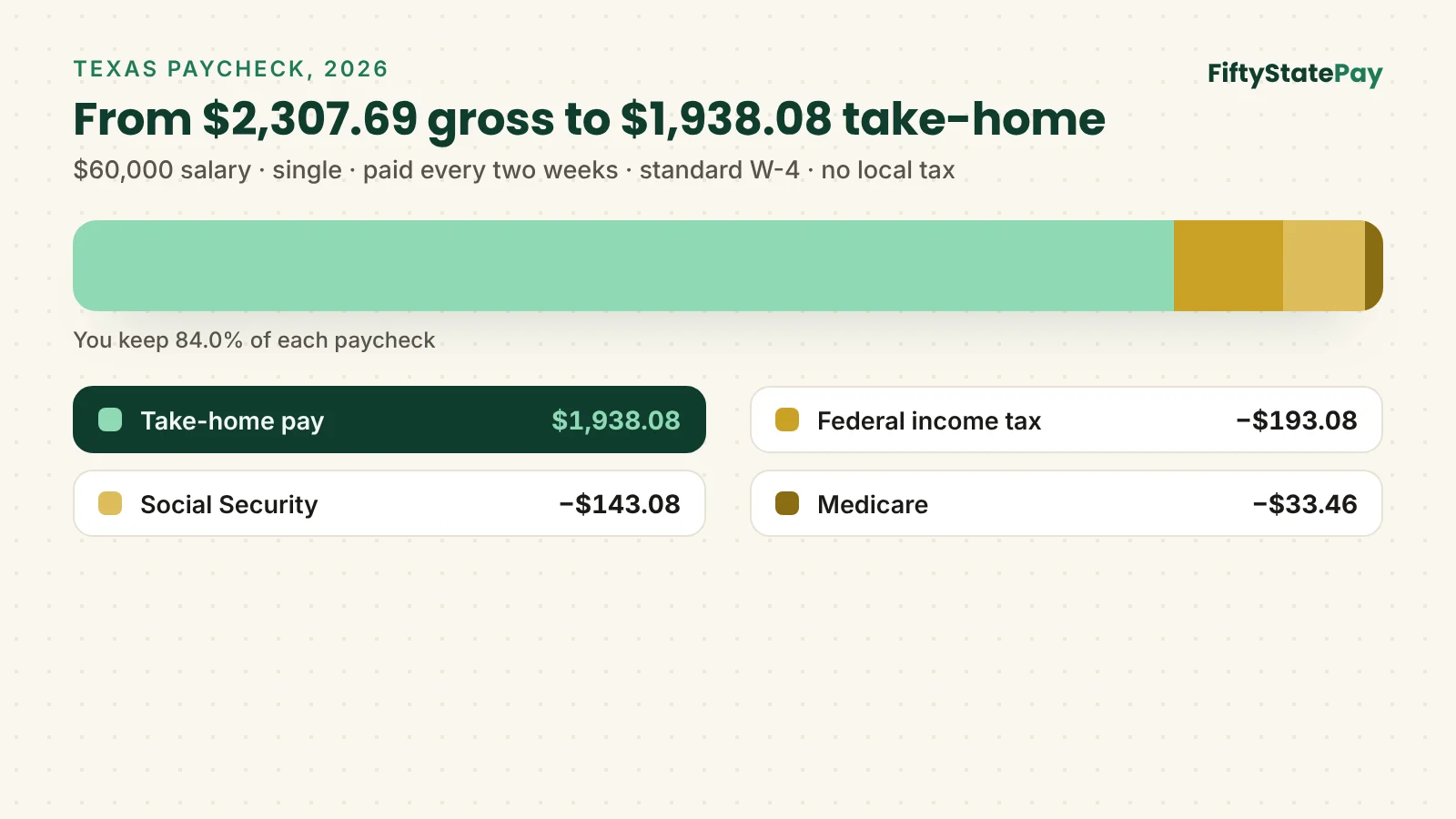
The $8,600 figure comes from the IRS worksheet in Publication 15-T. It builds most of the standard deduction into withholding, so your employer does not over-withhold.
Texas Take-Home Pay by Salary
Quick answer
In Texas, a $50,000 salary leaves about $42,355 a year after taxes, and $75,000 leaves about $61,592. At $100,000 you keep about $79,180, or 79% of your pay. These figures assume a single filer paid every two weeks with no pre-tax deductions.
| Salary | Federal income tax | State income tax | Social Security + Medicare | Take-home pay per year | Per paycheck |
|---|---|---|---|---|---|
| $30,000 | $1,420 | $0 | $2,295 | $26,285 | $1,010.96 |
| $40,000 | $2,620 | $0 | $3,060 | $34,320 | $1,320.00 |
| $50,000 | $3,820 | $0 | $3,825 | $42,355 | $1,629.04 |
| $60,000 | $5,020 | $0 | $4,590 | $50,390 | $1,938.08 |
| $75,000 | $7,670 | $0 | $5,738 | $61,592 | $2,368.94 |
| $100,000 | $13,170 | $0 | $7,650 | $79,180 | $3,045.38 |
| $150,000 | $24,734 | $0 | $11,475 | $113,791 | $4,376.58 |
| $200,000 | $36,734 | $0 | $14,339 | $148,927 | $5,727.96 |
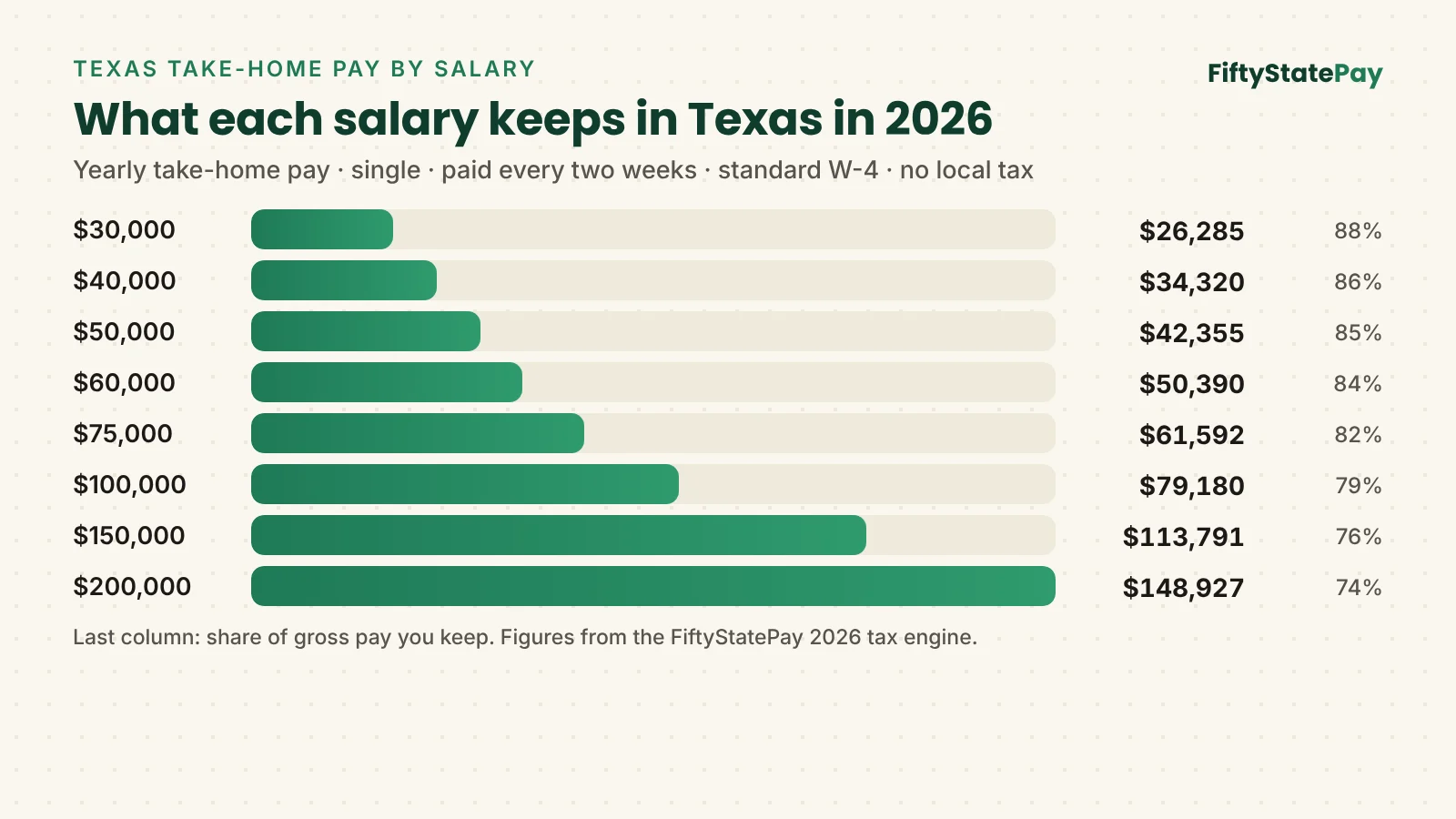
Notice how your share falls as pay rises. That happens because federal tax brackets climb from 10% to 37%. Meanwhile, Social Security stops once your wages pass $184,500 for the year, so very high earners see a bigger check late in the year.
Texas Hourly Paycheck Calculator
Quick answer
At $20 an hour and 40 hours a week, a single Texas worker earns $800 gross and takes home $684.72 each week in 2026. Add five overtime hours at time and a half, and weekly take-home rises to $805.25. Texas follows the federal minimum wage of $7.25 an hour.
| Item | 40 hours | 40 hours + 5 overtime |
|---|---|---|
| Gross pay | $800.00 | $950.00 |
| Federal income tax | −$54.08 | −$72.08 |
| Social Security | −$49.60 | −$58.90 |
| Medicare | −$11.60 | −$13.78 |
| Take-home pay | $684.72 | $805.25 |
Texas has no separate overtime law, so the federal Fair Labor Standards Act applies. Most hourly workers earn 1.5 times their rate after 40 hours in a week. To try your own hours, switch the Texas paycheck calculator above to Hourly.
Federal Taxes on Every Texas Paycheck
Quick answer
Every Texas paycheck still pays three federal taxes. Federal income tax depends on your W-4 and pay. Social Security is 6.2% of wages up to $184,500 in 2026, and Medicare is 1.45% of all wages. In addition, employers withhold 0.9% more Medicare once your wages pass $200,000.
| Tax rate | Single | Married filing jointly |
|---|---|---|
| 10% | $0 – $12,400 | $0 – $24,800 |
| 12% | $12,401 – $50,400 | $24,801 – $100,800 |
| 22% | $50,401 – $105,700 | $100,801 – $211,400 |
| 24% | $105,701 – $201,775 | $211,401 – $403,550 |
| 32% | $201,776 – $256,225 | $403,551 – $512,450 |
| 35% | $256,226 – $640,600 | $512,451 – $768,700 |
| 37% | Over $640,600 | Over $768,700 |
Source: IRS Revenue Procedure 2025-32. The 2026 standard deduction is $16,100 for single filers, $32,200 for married couples filing jointly and $24,150 for heads of household.
Your employer does not use these brackets directly. Instead, payroll uses the IRS percentage method, which spreads your yearly tax evenly across your paychecks. That is why the Texas paycheck calculator follows Publication 15-T rather than the brackets alone.
Texas vs. Other States: Paycheck Comparison
Quick answer
On a $60,000 salary, a Texas worker keeps $50,390 a year, the same as in Florida. The same salary keeps $47,807 in California and $47,424 in New York. So living in Texas is worth about $2,600 to $3,000 a year at this income, before housing and other costs.
| Texas | None | $50,390 | $79,180 |
|---|---|---|---|
| Florida | None | $50,390 | $79,180 |
| California | $1,803 | $47,807 | $72,320 |
| New York | $2,676 | $47,424 | $73,842 |
| Illinois | $2,825 | $47,565 | $74,375 |
| Georgia | $2,246 | $48,144 | $74,938 |
| North Carolina | $1,924 | $48,466 | $75,618 |
Moving for a job? Then compare the full cost of living, not just the paycheck. For example, California’s higher wages can outweigh its income tax in some careers. Open any state from our paycheck calculators by state to check.
Bonuses and Overtime on a Texas Paycheck
Quick answer
Texas does not tax bonuses, so only federal tax and FICA apply. Most employers withhold a flat 22% federal tax on a bonus paid separately. On a $5,000 bonus, that leaves about $3,517.50 after 22% federal tax, 6.2% Social Security and 1.45% Medicare.
Keep in mind that 22% is only withholding. Your real tax on the bonus depends on your total income for the year, so you may get some back at tax time.
Overtime works the same way. From 2025 through 2028, a new federal deduction lets many workers deduct part of their overtime premium when they file. However, Social Security and Medicare still apply, and withholding only changes if you claim it on Form W-4, Step 4(b). Our pay tools include overtime and bonus calculators.
How to Raise Your Texas Take-Home Pay
Quick answer
The simplest way is to use pre-tax benefits. On a $75,000 Texas salary, putting 6% into a 401(k) adds $173.08 to savings each paycheck. Yet your take-home pay drops by only $135.00, because federal tax falls by $38.08. Updating your W-4 can also stop over-withholding.
- Contribute to a traditional 401(k) or 403(b). In 2026 you can put in up to $24,500, plus $8,000 more if you are 50 or older.
- Use an HSA if you have a high-deductible health plan. It lowers federal income tax and, through a cafeteria plan, Social Security and Medicare too.
- Check your W-4 after a big refund. A large refund means too much was withheld all year.
- Claim your children in Step 3 of the W-4: $2,200 for each child under 17 and $500 for each other dependent.
Use the IRS estimator once a year
The IRS Tax Withholding Estimator compares your withholding with your likely tax bill. It is free and takes about 15 minutes with a recent pay stub.
Why Your Texas Paycheck May Look Different
Our Texas paycheck calculator follows the official formulas. Even so, a real pay stub can differ. Here are the usual reasons:
- Benefits such as health, dental and vision premiums, or a 401(k) match.
- Your W-4 settings, including extra withholding in Step 4(c).
- A different pay schedule, such as semimonthly instead of biweekly.
- Wage garnishments, union dues or other after-tax deductions.
- Year-to-date wages above $184,500, when Social Security stops for the year.
If the gap is still large, read how we calculate or contact us with your inputs. We will check it.
Texas Paycheck Calculator FAQ
How much tax is taken out of a paycheck in Texas?
Only federal taxes. For a single person earning $60,000, about 16% of each check goes to federal income tax, Social Security and Medicare. Texas takes nothing because it has no state income tax.
Does Texas have state income tax on paychecks?
No. Texas does not tax wages, and its constitution bans a personal income tax unless voters approve one. Federal income tax and FICA still apply.
What is $60,000 a year after taxes in Texas?
About $50,390 a year, or $1,938.08 every two weeks, for a single filer with no pre-tax deductions in 2026.
What is $100,000 a year after taxes in Texas?
About $79,180 a year, or $3,045.38 per biweekly paycheck, for a single filer in 2026.
How much is $20 an hour after taxes in Texas?
About $684.72 a week for 40 hours, or roughly $35,606 a year, for a single filer in 2026.
Do I need a state W-4 in Texas?
No. Texas has no state withholding form. You only fill out the federal Form W-4 for your employer.
Is this Texas paycheck calculator accurate for 2026?
Yes. It uses the 2026 IRS Publication 15-T tables, the $184,500 Social Security wage base and the 2026 W-4 rules. Your employer’s benefits can still change the final number.
Estimates, not tax advice
This Texas paycheck calculator gives estimates based on 2026 federal rules. It is not tax, legal or financial advice. Your employer’s payroll settings decide your real withholding. For personal advice, ask a CPA or an enrolled agent.
Sources
- IRS Publication 15-T (2026), Federal Income Tax Withholding MethodsInternal Revenue Service Official
- Contribution and Benefit Base (2026 Social Security wage base)Social Security Administration Official
- Tax Withholding EstimatorInternal Revenue Service Official
- Texas Constitution, Article 8, Section 24-aTexas Legislature Official
- Unemployment TaxTexas Workforce Commission Official
- State Minimum Wage LawsU.S. Department of Labor Official
Check your Texas paycheck now
Now you know what comes out of a Texas paycheck and why. Scroll back up to the Texas paycheck calculator, enter your own pay, and see your 2026 take-home pay in seconds.