

Free pay tool · federal overtime rules · 2026 taxes
Overtime Calculator: Overtime Pay Before and After Taxes
Use this overtime calculator to see what your extra hours are worth. Enter your hourly rate, your regular and overtime hours and the overtime rate, and you get your overtime pay per week, per paycheck and per year, before and after 2026 taxes.
Overtime pay is the higher rate you earn for hours over 40 in a workweek. Federal law sets it at least 1.5 times your regular rate, which is why it is often called time and a half.
- Time and a half or double time
- Take-home overtime after tax
- Federal FLSA rules explained
- Free, private, no sign-up
2026Pay tool
Estimates for paychecks paid in 2026 using each agency’s published withholding method. Your employer’s payroll may differ by a few cents through rounding or plan details. This is not tax, legal or financial advice.
Last updated October 21, 2026 · By Hamza Akram · How we calculate
How to Use the Overtime Calculator
Quick answer
Enter your hourly rate, your regular weekly hours and your overtime hours. Then choose 1.5× or 2× and pick your pay frequency, state and filing status. The overtime calculator shows your overtime pay a week, your gross and take-home pay per paycheck, and how much of each overtime hour you keep.
Enter your hourly rate.
Use your regular rate before overtime.
Enter regular hours.
Usually 40. Overtime under federal law starts after 40 hours in a workweek.
Enter overtime hours.
Count the hours over 40 in a typical week.
Choose the overtime rate.
Pick 1.5× for time and a half or 2× for double time.
Add your state and status.
These set the taxes, so you see what overtime adds to your take-home pay.
How Is Overtime Calculated?
Quick answer
Overtime is calculated by multiplying your regular hourly rate by 1.5, then by your overtime hours. At $20 an hour, the overtime rate is $30. Ten overtime hours therefore add $300 to your week. Your total pay for 50 hours is $800 regular plus $300 overtime, or $1,100.
Worked exampleOvertime pay for a 50-hour week
A worker earns $20 an hour and works 50 hours in one workweek.
- Regular pay: 40 hours × $20 = $800
- Overtime rate: $20 × 1.5 = $30
- Overtime pay: 10 hours × $30 = $300
- Total gross pay: $800 + $300 = $1,100
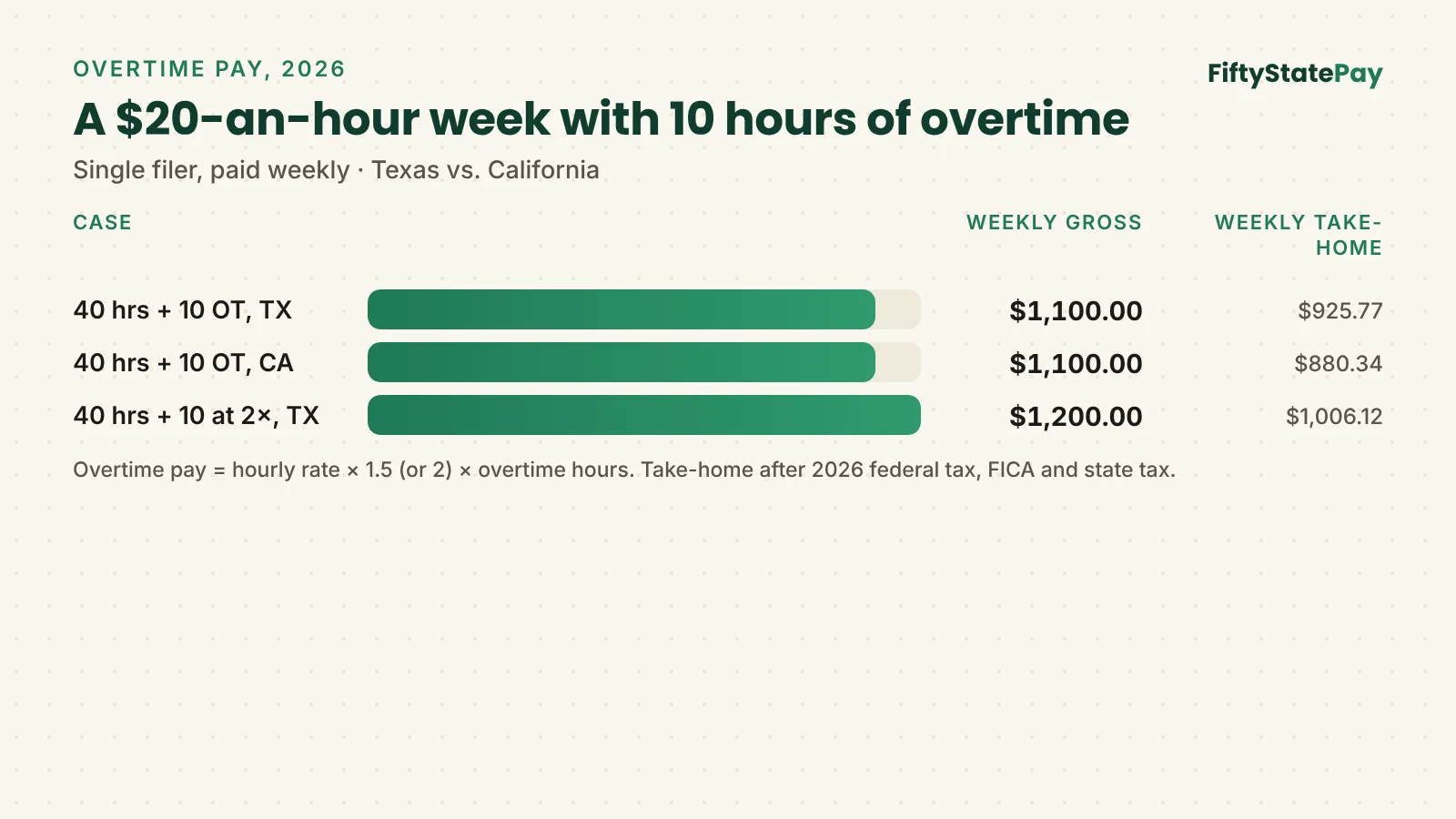
After 2026 taxes, a single filer paid weekly in Texas keeps $925.77 of that week, including $241.05 from overtime.
Federal law counts overtime week by week. A workweek is any fixed, repeating period of 168 hours, such as Sunday to Saturday. Your employer cannot average two weeks together, so 30 hours one week and 50 the next still means 10 overtime hours.
| Hourly rate | Overtime rate | 40 hrs + 5 OT | 40 hrs + 10 OT | 40 hrs + 20 OT |
|---|---|---|---|---|
| $15.00 | $22.50 | $712.50 | $825.00 | $1,050.00 |
| $18.00 | $27.00 | $855.00 | $990.00 | $1,260.00 |
| $20.00 | $30.00 | $950.00 | $1,100.00 | $1,400.00 |
| $22.00 | $33.00 | $1,045.00 | $1,210.00 | $1,540.00 |
| $25.00 | $37.50 | $1,187.50 | $1,375.00 | $1,750.00 |
| $30.00 | $45.00 | $1,425.00 | $1,650.00 | $2,100.00 |
| $35.00 | $52.50 | $1,662.50 | $1,925.00 | $2,450.00 |
| $40.00 | $60.00 | $1,900.00 | $2,200.00 | $2,800.00 |
Overtime Calculator With Tax: What You Keep
Quick answer
Overtime is taxed like regular wages, so you keep most of it but not all. With 10 overtime hours at $20 an hour, a single filer keeps $241.05 of the extra $300 in Texas and $219.70 in California. That works out to about $24.11 and $21.97 per overtime hour.
| Case | Weekly gross | Weekly take-home | Overtime kept |
|---|---|---|---|
| Texas, 1.5× | $1,100.00 | $925.77 | $241.05 |
| California, 1.5× | $1,100.00 | $880.34 | $219.70 |
| Texas, 2× (double time) | $1,200.00 | $1,006.12 | $321.40 |
Overtime can push part of your pay into a higher federal bracket, but only the extra dollars are taxed at that rate. Also, a new federal deduction for 2025 to 2028 can cut the income tax on the overtime premium when you file. See our no tax on overtime calculator.
Who Gets Overtime Pay?
Quick answer
Most hourly workers and many salaried workers are "nonexempt" and must get overtime under the Fair Labor Standards Act. Salaried workers earning less than $684 a week generally qualify too. Exempt workers, such as many managers and professionals paid above that level, do not get federal overtime.
- Hourly workers: almost always nonexempt, so overtime applies after 40 hours.
- Salaried under $684 a week ($35,568 a year): generally nonexempt.
- Salaried above that: exempt only if their duties meet an executive, administrative or professional test.
- Some jobs have special rules, such as certain farm, transport and commission sales workers.
- Independent contractors are not employees, so the FLSA overtime rule does not cover them.
Not sure about your status? The Department of Labor’s free FLSA Overtime Calculator Advisor walks you through the rules.
Double Time and State Overtime Laws
Quick answer
Federal law does not require double time. However, a few states add daily overtime rules. California, for example, requires 1.5× after 8 hours in a day and 2× after 12 hours. Union contracts and employer policies can also promise double time for holidays or long shifts.
Federal law also does not require extra pay for weekends, holidays or nights, unless those hours push you over 40 in the week. So holiday pay depends on your employer’s policy or contract. When a state law and federal law differ, your employer must follow the one that pays you more.
What Counts in Your Regular Rate
Overtime is based on your "regular rate," which can be higher than your base wage. Nondiscretionary bonuses, shift differentials and some commissions must be included. For example, a production bonus earned that week raises the rate used for overtime.
Here is a simple case. A worker earns $15 an hour for 45 hours and a $90 attendance bonus. The regular rate is ($15 × 45 + $90) ÷ 45 = $17. So each of the 5 overtime hours earns an extra half of $17, or $8.50, on top of the straight-time pay already counted. As a result, the overtime premium is $42.50 instead of $37.50.
Related Pay Calculators
Time and a half calculator
Gives your 1.5× and 2× rates.
No tax on overtime calculator
Estimates the 2025–2028 overtime deduction.
Hourly to salary calculator
Turns a wage into a yearly salary.
Bonus tax calculator
Splits a bonus into tax and take-home.
Need your full paycheck? Open the paycheck calculator for your state, or see all free pay tools.
Overtime Calculator FAQ
How do I calculate overtime pay?
Multiply your hourly rate by 1.5, then by your overtime hours. At $20 an hour, 10 overtime hours pay $20 × 1.5 × 10 = $300.
When does overtime start?
Under federal law, after 40 hours worked in a workweek. Some states, such as California, also count daily hours.
Is overtime taxed more than regular pay?
No. Overtime is taxed as regular wages. It can move some income into a higher bracket, but only the extra dollars pay that rate.
Do salaried employees get overtime?
Nonexempt salaried workers do, including most paid under $684 a week. Exempt managers and professionals generally do not.
Is holiday pay overtime?
Not under federal law. Holiday premiums come from your employer’s policy or contract, unless the hours take you over 40 in the week.
Can my employer average hours over two weeks?
No. Federal overtime is figured for each workweek separately, even if you are paid every two weeks.
Does this overtime calculator include taxes?
Yes. It shows your gross overtime and your take-home pay after 2026 federal, FICA and state taxes.
Estimates, not legal advice
This overtime calculator gives estimates based on federal overtime rules and 2026 tax rules. It is not legal, tax or financial advice. If you think you are owed overtime, contact the U.S. Department of Labor or your state labor agency.
Sources
- Overtime PayU.S. Department of Labor, Wage and Hour Division Official
- FLSA Overtime Calculator AdvisorU.S. Department of Labor Official
- Fact Sheet 17A: Exemption for Executive, Administrative, Professional, Computer and Outside Sales EmployeesU.S. Department of Labor Official
- IRS Publication 15-T (2026), Federal Income Tax Withholding MethodsInternal Revenue Service Official
Calculate your overtime
Now you know how overtime is figured and taxed. Enter your rate and hours in the overtime calculator above to see what your extra hours really pay.