

Free pay tool · updated for 2026
Pay Raise Calculator: Your New Salary and What You Keep
Use this pay raise calculator to see your new salary after a raise, and how much more you take home per paycheck. Enter your current salary and your raise as a percent or a dollar amount, then choose your state.
A pay raise is an increase in your gross pay, usually given as a percentage of your current salary. Because taxes take a share of the extra dollars, the calculator also shows how much of the raise you keep after 2026 taxes.
- Raise by percent or dollars
- Extra take-home per paycheck
- 2026 federal and state tax rules
- Free, private, no sign-up
2026Pay tool
Estimates for paychecks paid in 2026 using each agency’s published withholding method. Your employer’s payroll may differ by a few cents through rounding or plan details. This is not tax, legal or financial advice.
Last updated October 21, 2026 · By Hamza Akram · How we calculate
How to Use the Pay Raise Calculator
Quick answer
Enter your current salary, then type your raise and choose % or $. Next, pick your pay frequency, state and filing status. The pay raise calculator shows your new salary, the extra gross and take-home pay per paycheck, the extra take-home for the year and the share of the raise you keep.
Enter your current salary.
Use your yearly base pay before taxes.
Enter the raise.
Type a percentage, such as 4, or switch to dollars, such as 2,500.
Choose how often you are paid.
This sets the per-paycheck figures.
Pick your state and status.
Taxes on the raise depend on both.
Read the results.
See your new salary, the extra per paycheck and how much of the raise you keep.
How to Calculate a Pay Raise
Quick answer
To calculate a pay raise, multiply your current salary by the raise percentage and add the result to your salary. A 5% raise on $60,000 is $60,000 × 0.05 = $3,000, so your new salary is $63,000. To find the percentage from two salaries, divide the difference by the old salary.
Worked examplePay raise formulas with real numbers
Two common questions, worked through:
- New salary from a percent: $55,000 × 1.04 = $57,200 (a 4% raise adds $2,200).
- Percent from two salaries: ($57,200 − $55,000) ÷ $55,000 = 0.04, or 4%.
- Hourly raise: $20.00 × 1.04 = $20.80 an hour, which is $1,664 more a year at 2,080 hours.
- Raise per paycheck: $2,200 ÷ 26 = $84.62 more gross every two weeks.
| Raise | New salary | Extra a year (gross) | Extra every two weeks (gross) |
|---|---|---|---|
| 2% | $61,200 | $1,200 | $46.15 |
| 3% | $61,800 | $1,800 | $69.23 |
| 4% | $62,400 | $2,400 | $92.31 |
| 5% | $63,000 | $3,000 | $115.38 |
| 6% | $63,600 | $3,600 | $138.46 |
| 8% | $64,800 | $4,800 | $184.62 |
| 10% | $66,000 | $6,000 | $230.77 |
| 15% | $69,000 | $9,000 | $346.15 |
How Much of a Raise Do You Keep After Taxes?
Quick answer
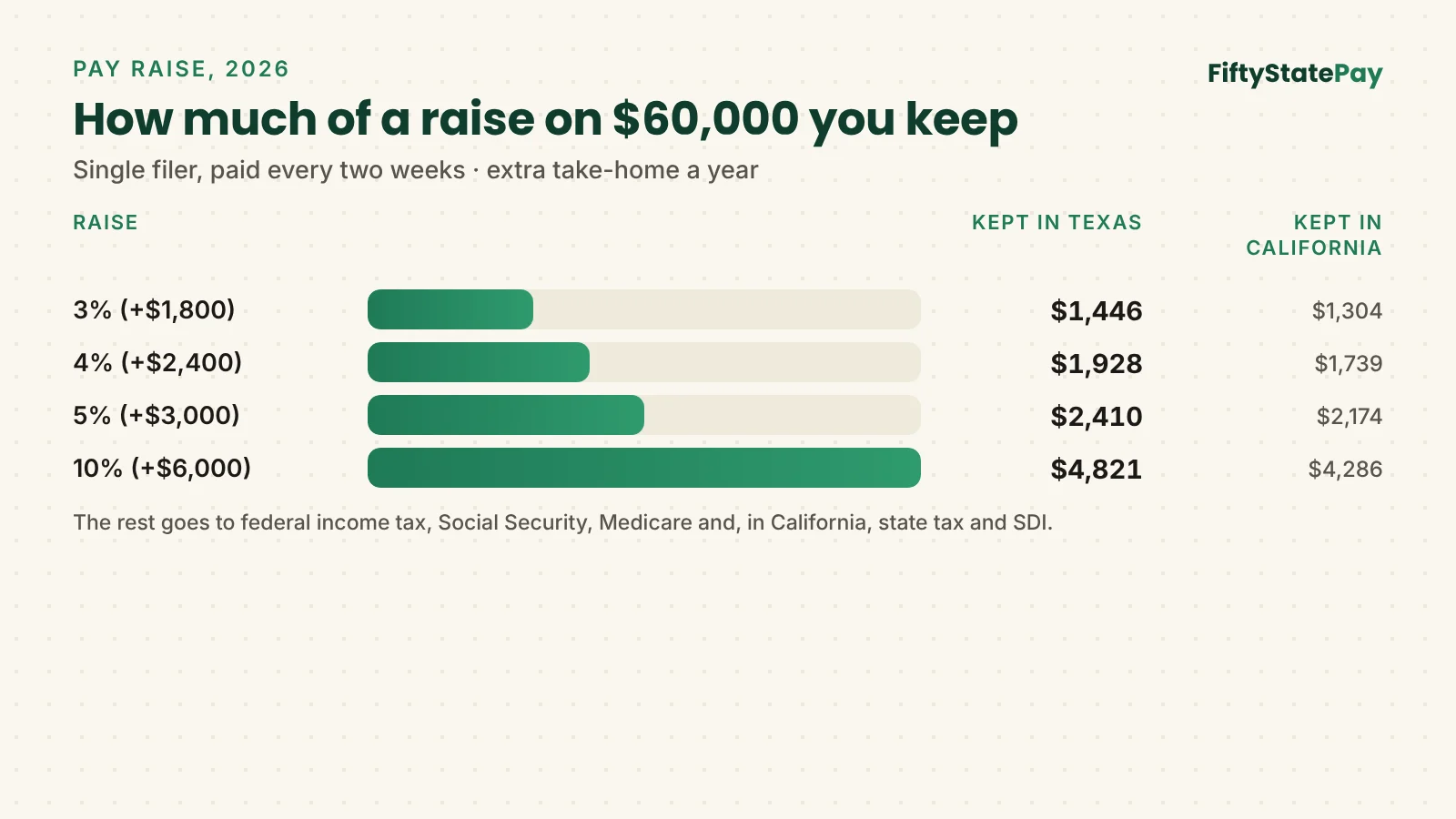
Most people keep about 70% to 80% of a raise. On a $60,000 salary, a single filer keeps $2,410 of a $3,000 raise in Texas, or about 80%. In California the same raise leaves $2,174, because state tax and SDI also apply. The pay raise calculator shows your exact share.
| Raise | Gross added | Kept in Texas (year) | Kept in Texas (per check) | Kept in California (year) | Kept in California (per check) |
|---|---|---|---|---|---|
| 3% | $1,800 | $1,446 | $55.63 | $1,304 | $50.16 |
| 4% | $2,400 | $1,928 | $74.17 | $1,739 | $66.88 |
| 5% | $3,000 | $2,410 | $92.71 | $2,174 | $83.60 |
| 10% | $6,000 | $4,821 | $185.42 | $4,286 | $164.86 |
Can a raise lower your take-home pay?
No, not through income tax. The U.S. uses marginal brackets, so only the dollars above a bracket line are taxed at the higher rate. Your existing pay is taxed the same as before. However, a raise can reduce income-based benefits, such as the Earned Income Tax Credit or some health subsidies, so check those separately.
Hourly Pay Raise Calculator
Quick answer
For an hourly raise, multiply your rate by 1 plus the raise percentage. A 3% raise turns $20.00 into $20.60, which adds $1,248 a year at 2,080 hours. Likewise, a 5% raise on $25.00 gives $26.25 an hour, or $2,600 more a year before taxes.
| Current rate | 3% raise | 5% raise | Extra a year at 3% | Extra a year at 5% |
|---|---|---|---|---|
| $15.00 | $15.45 | $15.75 | $936 | $1,560 |
| $18.00 | $18.54 | $18.90 | $1,123 | $1,872 |
| $20.00 | $20.60 | $21.00 | $1,248 | $2,080 |
| $22.00 | $22.66 | $23.10 | $1,373 | $2,288 |
| $25.00 | $25.75 | $26.25 | $1,560 | $2,600 |
| $30.00 | $30.90 | $31.50 | $1,872 | $3,120 |
To use the pay raise calculator for hourly pay, first convert your wage to a yearly amount with our hourly to salary calculator. Then enter that salary and your raise.
Pay Raise vs. Inflation: Is Your Raise Real?
Quick answer
A raise only increases your buying power if it beats inflation. To estimate your real raise, subtract the inflation rate from your raise. For example, a 4% raise in a year with 3% inflation is roughly a 1% real raise. If inflation is higher than your raise, your pay buys less than before.
The exact formula is (1 + raise) ÷ (1 + inflation) − 1. With a 4% raise and 3% inflation, that gives 1.04 ÷ 1.03 − 1 = 0.97%. For current inflation, check the Consumer Price Index from the Bureau of Labor Statistics.
Types of Raises: Merit, Promotion and Cost of Living
Merit raise
Based on your performance review, usually once a year.
Promotion raise
Comes with a new title or more responsibility, so it is often larger.
Cost-of-living adjustment (COLA)
Meant to keep pace with inflation, and often the same for everyone.
Market adjustment
Brings your pay up to what similar jobs pay elsewhere.
How to Ask for a Raise With Real Numbers
Numbers make a raise request stronger. Before you talk to your manager, prepare these points:
- Look up typical pay for your job and area in the BLS Occupational Employment and Wage Statistics.
- List your results from the past year, with numbers where you can.
- Decide on a target raise and a minimum you would accept.
- Use the pay raise calculator to see what each option means per paycheck after taxes.
- Ask about benefits too, such as a higher 401(k) match or extra paid time off.
Related Pay Calculators
Salary to hourly calculator
Converts a salary to an hourly wage.
Hourly to salary calculator
Turns a wage into a yearly salary.
Bonus tax calculator
Splits a bonus into tax and take-home.
Federal income tax calculator
Estimates 2026 tax, refund or amount owed.
Need your full paycheck? Open the paycheck calculator for your state, or see all free pay tools.
Pay Raise Calculator FAQ
How do I calculate a percentage raise?
Subtract your old salary from your new one, divide by the old salary and multiply by 100. For example, ($57,200 − $55,000) ÷ $55,000 = 4%.
What is a 5% raise on $60,000?
$3,000 a year, for a new salary of $63,000. A single filer keeps about $2,410 of it in Texas after 2026 taxes.
How much of my raise will I keep after taxes?
Usually 70% to 80%, depending on your tax bracket and state. The pay raise calculator shows your exact share.
Can a raise put me in a higher tax bracket and lower my pay?
No. Only the extra dollars are taxed at the higher rate, so your take-home pay still rises. Income-based benefits are a separate question.
How do I calculate an hourly pay raise?
Multiply your hourly rate by 1 plus the raise. A 4% raise on $20 an hour is $20 × 1.04 = $20.80.
Is a 3% raise good?
It depends on inflation and your market. If prices rose more than 3% that year, your real pay fell slightly.
Estimates, not financial advice
This pay raise calculator gives estimates based on 2026 tax rules. It is not tax, legal or financial advice. Your employer’s payroll and benefits decide your actual pay.
Sources
- IRS releases tax inflation adjustments for tax year 2026 (IR-2025-103)Internal Revenue Service Official
- IRS Publication 15-T (2026), Federal Income Tax Withholding MethodsInternal Revenue Service Official
- Consumer Price IndexU.S. Bureau of Labor Statistics Official
- Occupational Employment and Wage StatisticsU.S. Bureau of Labor Statistics Official
Check your raise now
Now you know how a raise is figured and taxed. Enter your salary and raise in the pay raise calculator above to see what you will really keep.