

Standards · People-first content · Updated each tax year
Editorial Policy: How We Research, Write and Update
Our editorial policy explains how FiftyStatePay researches, writes, checks and updates its paycheck and tax content. Money topics need extra care, so we hold every page to the same written standards.
You will also see who writes the content, how we use AI, how advertising is kept apart from the facts, and how to report a mistake.
- Primary sources first
- Named author, honest about limits
- Ads never shape content
- Dated updates and open corrections
Last updated October 21, 2026 · By Hamza Akram · Contact us
Our Editorial Policy: Five Standards
Quick answer
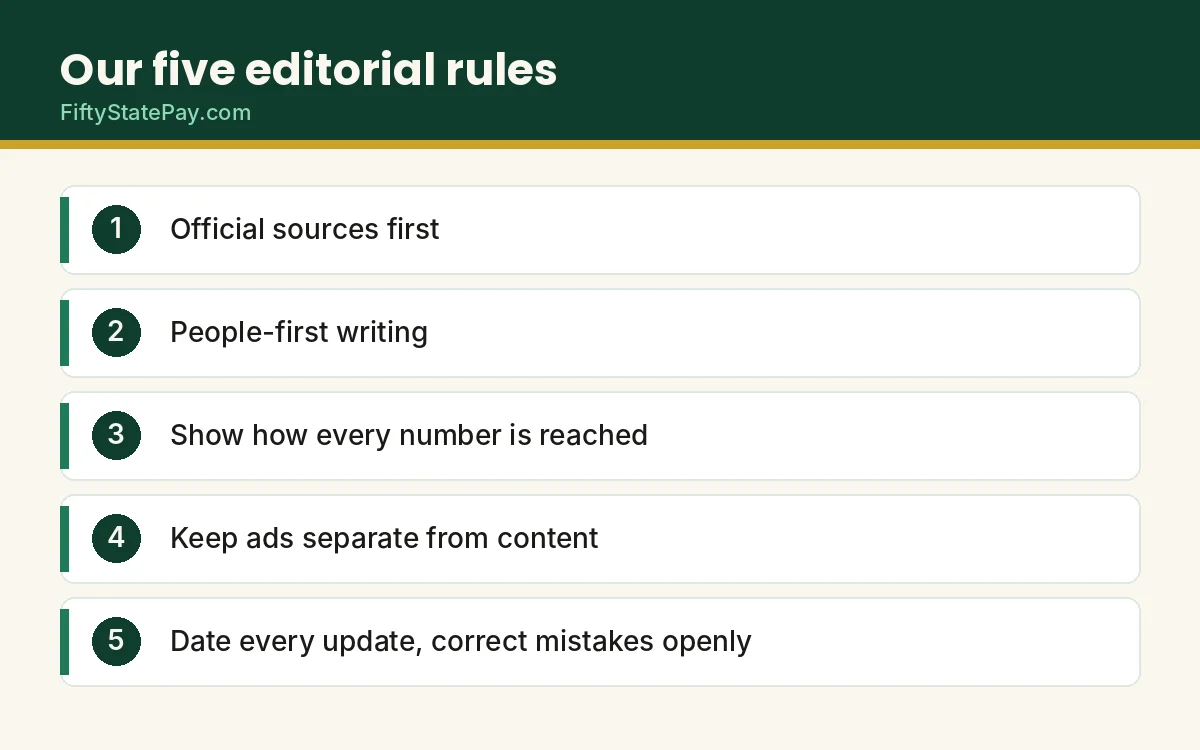
Our editorial policy has five rules. Use official sources first. Write for readers, not for search engines. Show how a number was reached. Keep advertising separate from content. Date every update and correct mistakes openly. Each page is checked against these rules before it is published.
Sources first
Every rate, limit and rule links to an IRS, SSA or state agency source.
People first
Pages answer a real question, in plain English, without padding.
Show the work
We explain how each number is calculated.
Separate from ads
Ads never change a result, a ranking or a recommendation.
Editorial Policy: Who Writes and Edits Our Content
Hamza Akram writes, builds and edits all content on FiftyStatePay. He is a digital marketer and web developer. He is not a CPA, an enrolled agent or an attorney, and no page claims otherwise.
Because of that, we stay close to published rules, we show every source, and we send you to a qualified professional for advice about your own taxes. If a qualified reviewer checks a page in the future, we will name that person and their credential on that page.
You can read more on the meet the team page, which also covers the background behind this editorial policy.
How We Research and Fact-Check
Start with the question.
We pick topics people actually ask about, such as “how is overtime taxed?”
Find primary sources.
We read the IRS publication, the SSA notice or the state agency guide, not a summary.
Calculate and test.
We run the numbers through our calculators and compare them with official worked examples.
Write in plain English.
We explain terms, show an example and keep sentences short.
Check before publishing.
We re-check every figure, date and link against its source.
We never invent statistics, quotes, laws or reviews. If we cannot confirm a figure from a reliable source, we leave it out. Our tax data sources page lists where the numbers come from, and how we calculate explains the math.
Our Editorial Policy on AI Use
AI use
We use AI-assisted tools to help draft, edit and build the site. They do not decide any tax figure. Numbers come from official sources and our tested calculators, and Hamza Akram reviews every figure, rule and link before a page goes live.
We do not publish AI-made reviews, invented quotes or fake experts. Nor do we publish content that nobody has checked. Our aim matches Google’s guidance: content created for people that is accurate and helpful.
Independence and Advertising
FiftyStatePay earns money from Google AdSense ads. Advertisers do not see our content before publication, and they cannot pay for a better result, a higher ranking or a kind word. The advertising disclosure explains how ads work.
If we ever add affiliate links or sponsored content, we will label each one clearly, and the same sourcing rules will apply.
How We Update Our Content
Tax content goes out of date quickly, so we update on a schedule.
| What | When we update it | Where we record it |
|---|---|---|
| Federal tables, limits and rates | Each January, and when the IRS issues a change | Tax updates log |
| Social Security wage base | Each fall, when the SSA announces it | Tax updates log |
| State rates and formulas | Each January and whenever a state changes them | Tax updates log |
| Guides and tool pages | Each tax year, and when a source changes | Page “last updated” date |
Corrections Under Our Editorial Policy
Everyone makes mistakes, and money content must fix them fast. That is why our editorial policy has a corrections policy explains how to report an error, how quickly we respond, and how we mark each fix. In short, we verify, correct, and note the change.
What We Will Not Publish
- Personal tax, legal or investment advice.
- Figures we cannot trace to an official or reliable source.
- Fake reviews, invented quotes, or made-up experts.
- Content that copies another site.
- Results that change because an advertiser or partner asks.
Frequently Asked Questions About Our Editorial Policy
Does FiftyStatePay use AI to write content?
We use AI-assisted tools to help draft, edit and build. They do not set any tax figure, and Hamza Akram reviews every number, rule and link before publishing.
Who checks FiftyStatePay content?
Hamza Akram checks it against primary sources and tests the calculators against official examples. He is not a CPA, so we link every source and encourage you to confirm anything important.
How often is FiftyStatePay updated?
Federal and state data are updated each January and whenever a rule changes. We date each change in the tax updates log.
Does advertising affect your content?
No. Ads come from Google AdSense, and advertisers cannot influence a calculation, a guide or a recommendation.
Is the author a CPA?
No. The author is a digital marketer and web developer who relies on official sources. We say so openly, and we recommend a CPA or enrolled agent for personal advice.
How do I report an error?
Use the contact form and choose “Correction to a page or guide.” Include the page link and the source you checked. We will review it as set out in our corrections policy.
Estimates, not tax advice
Our content explains how paychecks and payroll taxes work in general. It is not tax, legal or financial advice. For your own situation, check the IRS Tax Withholding Estimator or ask a tax professional.
Sources
- Google Search EssentialsGoogle Search Central
- Creating helpful, reliable, people-first contentGoogle Search Central
- IRS Publication 15-T (2026), Federal Income Tax Withholding MethodsInternal Revenue Service Official
- IRS Tax Withholding EstimatorInternal Revenue Service Official
Help us keep the numbers right
Our editorial policy only works if readers can challenge it. So if a figure looks wrong, tell us and we will check it against the source.