

Paycheck guides · 2026 tax year
Paycheck Deductions Explained: Payroll Taxes for Employees
These free guides explain paycheck deductions in plain English. You’ll learn what payroll taxes are, why Social Security and Medicare come out of every check, how your W-4 sets your withholding, and which benefits lower your taxes.
Each guide uses 2026 IRS and state rules, real dollar examples, and links to the official source. Start with the overview below, or jump straight to the topic you need.
- Based on IRS, SSA and state rules
- Updated for 2026 paychecks
- Real examples, no jargon
- Free to read, no sign-up
Last updated October 2026 · How we calculate · Tax data sources
Start Here: Guides to Paycheck Deductions and Payroll Taxes
Quick answer
Our guides cover the six topics behind most paycheck deductions: how to read a pay stub, gross vs. net pay, FICA tax, the W-4 form, federal tax brackets, and states with no income tax. Each guide answers one question in depth, with 2026 numbers and a worked example you can check with our calculator.
How to read a pay stub
Every line on your paycheck, decoded.
Gross vs. net pay
Where the money goes before payday.
FICA tax explained
Social Security and Medicare withholding in 2026.
W-4 form explained
Fill it in so your withholding is right.
Federal tax brackets
This year’s rates and how they really work.
States with no income tax
The nine states that don’t tax wages.
Prefer numbers to reading? Try the paycheck calculator, browse paycheck calculators by state, or open our free pay tools.
What Are Payroll Taxes?
Quick answer
Payroll taxes are taxes figured on wages and paid through your employer. For employees, they include federal income tax withholding, Social Security (6.2%), Medicare (1.45%), and any state and local income taxes. Employers pay their own share of Social Security and Medicare, plus federal and state unemployment taxes.
Strictly speaking, “payroll tax” often means only the taxes tied to wages, like Social Security and Medicare. In everyday use, however, it covers everything withheld from your check. The table below shows who pays each one in 2026.
| Payroll tax | Who pays | 2026 rate | Wage limit |
|---|---|---|---|
| Federal income tax | Employee (withheld) | 10% to 37% brackets | None |
| Social Security | Employee and employer | 6.2% each | $184,500 |
| Medicare | Employee and employer | 1.45% each | None |
| Additional Medicare Tax | Employee only | 0.9% | Wages over $200,000 |
| Federal unemployment (FUTA) | Employer only | 6.0%, usually 0.6% after credits | First $7,000 |
| State income tax | Employee (withheld) | 0% to 13.3% | None |
| Local income tax | Employee (withheld) | Varies by city or county | Varies |
| State disability and paid leave | Employee, employer, or both | Up to about 1.4% | Varies by state |
Note: State rates are 2026 statutory ranges. Local taxes apply in about a dozen states. See our state income tax rates table for every state.
Payroll Taxes for Employees vs. Employers
Quick answer
As an employee, you pay 7.65% in FICA taxes on most wages, plus income tax withholding. Your employer matches the 7.65% and also pays federal and state unemployment taxes. In other words, your job costs your employer more than your salary, even though those extra taxes never appear on your pay stub.
Employee pays
- Federal income tax withholding
- Social Security: 6.2% up to $184,500
- Medicare: 1.45%, plus 0.9% over $200,000
- State and local income taxes
- Some state disability and paid leave premiums
Employer pays
- Social Security: a matching 6.2%
- Medicare: a matching 1.45% (no extra 0.9%)
- Federal unemployment tax (FUTA)
- State unemployment tax (SUTA)
- Some state paid leave premiums
Self-employed workers pay both halves themselves. Their self-employment tax is 15.3% on 92.35% of net earnings, with the Social Security part capped at the wage base. They can, however, deduct half of it on their tax return.
Paycheck Deductions, in the Order They Come Out
Quick answer
Paycheck deductions come out in a set order. First, pre-tax deductions such as a 401(k) or health insurance lower your taxable pay. Next, federal income tax, Social Security, Medicare, and state and local taxes are figured. Finally, after-tax deductions such as a Roth 401(k) come out. What’s left is your net pay.
Here’s what that looks like on a real 2026 paycheck. This worker earns $60,000 in California, is single, and is paid every two weeks. She puts 5% into a traditional 401(k) and pays $75 per check for health insurance.
Biweekly pay stub: $60,000 salary in California (2026)
Earnings
- Gross pay$60,000 ÷ 26 paychecks
- $2,307.69
Pre-tax deductions
- 401(k)5% of gross pay
- −$115.38
- Health insuranceSection 125 plan
- −$75.00
Taxes
- Federal income taxIRS percentage method, single
- −$170.23
- Social Security6.2% of $2,232.69
- −$138.43
- Medicare1.45% of $2,232.69
- −$32.37
- California income taxForm DE 4, single, 1 allowance
- −$56.80
- California SDI1.3% of $2,232.69
- −$29.03
- Net paydeposited on payday
- $1,690.45
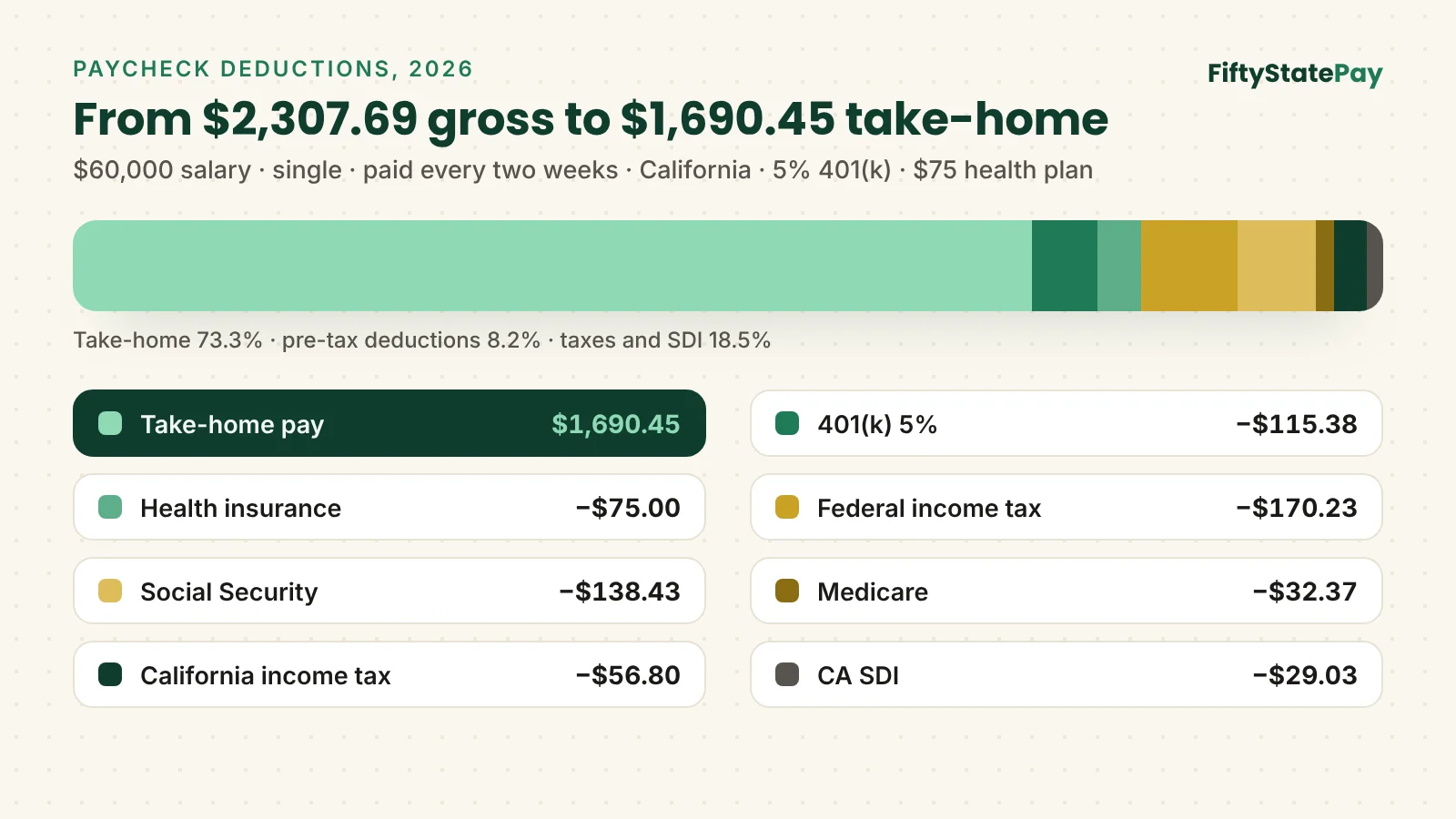
Look closely at the Social Security line. It’s figured on $2,232.69, not on gross pay, because health insurance through a cafeteria plan is free of FICA tax. By contrast, the 401(k) still counts for Social Security and Medicare.
The pre-tax deductions also pay for themselves in part. Together they total $190.38, yet her take-home pay drops by only $148.26 compared with no deductions, since they cut her taxes too.
Mandatory vs. Voluntary Paycheck Deductions
Quick answer
Mandatory paycheck deductions are required by law, so you can’t opt out of them. They include federal income tax, Social Security, Medicare, state and local taxes, and court-ordered garnishments. Voluntary deductions are ones you choose, such as retirement savings, health insurance, HSA or FSA contributions, and life insurance.
| Deduction | Type | Lowers your taxable pay? |
|---|---|---|
| Federal income tax | Mandatory | No |
| Social Security and Medicare (FICA) | Mandatory | No |
| State and local income tax | Mandatory | No |
| State disability or paid leave premium | Mandatory in some states | No |
| Wage garnishment or child support order | Mandatory when ordered | No |
| Traditional 401(k), 403(b), or 457 | Voluntary | Yes, for income tax |
| Roth 401(k) | Voluntary | No |
| Health, dental, and vision insurance | Voluntary | Yes, usually including FICA |
| HSA or FSA contributions | Voluntary | Yes, usually including FICA |
| Life or disability insurance | Voluntary | Usually no |
Union dues can also appear on your stub. They’re set by a union contract, and they come out after taxes.
Pre-Tax vs. After-Tax Paycheck Deductions
Quick answer
Pre-tax paycheck deductions come out before taxes are figured, so they lower your tax bill as well as your take-home pay. After-tax deductions come out last and don’t reduce your taxes. For example, a traditional 401(k) is pre-tax for income tax, while a Roth 401(k) is after-tax but grows tax-free.
| Pre-tax benefit | 2026 limit | Free of FICA tax? |
|---|---|---|
| 401(k), 403(b), or 457 plan | $24,500 (plus $8,000 catch-up at 50+) | No |
| Health savings account (HSA) | $4,400 self-only, $8,750 family | Yes, through a cafeteria plan |
| Health care FSA | $3,400 | Yes |
| Dependent care FSA | $7,500 per household | Yes |
| Transit and parking benefits | $340 a month each | Yes |
| Health, dental, and vision premiums | No set limit | Yes, through a cafeteria plan |
Note: Workers aged 60 to 63 can add a larger 401(k) catch-up of $11,250. The HSA catch-up at age 55 or older is $1,000.
A few states don’t follow the federal rules. Pennsylvania taxes 401(k) and 403(b) contributions for state and local tax, New Jersey taxes 403(b), 457, and HSA contributions, and California taxes HSA contributions. Our state calculators apply these rules for you.
FICA Tax: Social Security and Medicare
Quick answer
FICA tax is the federal payroll tax that funds Social Security and Medicare. In 2026, employees pay 6.2% for Social Security on wages up to $184,500 and 1.45% for Medicare on all wages. Above $200,000 in wages, an extra 0.9% Medicare tax applies. The most anyone pays in Social Security tax for 2026 is $11,439.
Because of that wage cap, high earners see a bigger paycheck late in the year. Once your year-to-date wages pass $184,500, Social Security tax stops until January. If you have two jobs and pay too much in total, you can claim the extra back on your tax return.
Read the full FICA tax guide for examples, or see the official wage base from the Social Security Administration.
Federal Income Tax Withholding and Form W-4
Quick answer
Your employer withholds federal income tax based on the Form W-4 you file and the IRS tables in Publication 15-T. The form asks for your filing status, other jobs, dependents, other income, and deductions. If you never file one, your employer must withhold as if you’re single with no adjustments.
Enter your personal details (Step 1).
Enter your name, address, and filing status. Your status sets your standard deduction and brackets.
Account for other jobs (Step 2).
Check the box or use the IRS estimator if you hold more than one job, so enough tax is withheld.
Claim your dependents (Step 3).
Enter $2,200 for each child under 17 and $500 for each other dependent, if your income qualifies.
Make other adjustments (Step 4).
Add other income, extra deductions, or extra tax to withhold each paycheck.
Sign and date the form (Step 5).
Hand it to your employer. Changes show up within a pay period or two.
A big refund means too much was withheld all year, while a balance due means too little. The IRS Tax Withholding Estimator helps you fine-tune it. Our W-4 guide walks through each step with examples.
How to Read a Pay Stub
Quick answer
To read a pay stub, start with gross pay at the top. Then check each deduction: pre-tax benefits, federal income tax, Social Security, Medicare, state and local taxes, and after-tax items. Net pay at the bottom is what you receive. The year-to-date column shows totals so far this year.
Pay stubs use short codes to save space. These are the ones you’ll see most often:
| Code on your stub | What it means |
|---|---|
| FIT or FITW | Federal income tax withheld |
| SS, OASDI, or FICA-SS | Social Security tax |
| MED or FICA-MED | Medicare tax |
| SIT or SWT | State income tax withheld |
| LIT or CITY | Local or city income tax |
| SDI, TDI, PFL, or FLI | State disability or paid leave premium |
| 401K or 401K-PRE | Traditional 401(k) contribution |
| ROTH or 401K-ROTH | Roth 401(k) contribution |
| YTD | Year to date: totals since January 1 |
Check your stub every few months. In particular, make sure your pay rate and hours are right, your filing status matches your W-4, and new benefits started on time. Our pay stub guide explains every section in detail.
Gross Pay vs. Net Pay
Quick answer
Gross pay is what you earn before any deductions, such as a $60,000 salary or $25 an hour. Net pay is what’s left after taxes and deductions, and it’s the amount deposited on payday. In the California example above, gross pay is $2,307.69 and net pay is $1,690.45, or about 73% of gross.
Your net pay share depends mostly on your state, your tax bracket, and the paycheck deductions you choose. For instance, a single worker earning $60,000 with no deductions keeps about 84% of gross pay in Texas but about 80% in California. Use the paycheck calculator to find your own number.
Key 2026 Numbers for Payroll Taxes and Paycheck Deductions
$184,500
Social Security wage base
6.2% up to this amount
7.65%
FICA tax on most wages
6.2% + 1.45%
$16,100
Standard deduction, single
$32,200 married filing jointly
$24,500
401(k) limit
plus catch-up at 50+
- Federal income tax brackets: 10%, 12%, 22%, 24%, 32%, 35%, and 37%.
- Child tax credit: $2,200 per qualifying child, entered in Step 3 of your W-4.
- Bonus withholding: a flat 22% federal rate, or 37% on bonuses over $1 million in a year.
- No tax on tips and overtime: new federal deductions for 2025 through 2028, claimed on your tax return.
- Additional Medicare Tax: 0.9% on wages over $200,000.
Paycheck Deductions Checklist: Catch Mistakes Early
Mistakes in paycheck deductions happen, and they’re easier to fix when you spot them early. Run through this list whenever your pay, job, or life changes:
- Your pay rate and hours match your offer letter or timecard.
- Your W-4 filing status and dependents are current.
- You filed your state withholding form, if your state has one.
- Your city or county tax is correct for where you live and work.
- Benefit deductions match what you chose at enrollment.
- Your 401(k) percentage is right, and you get the full employer match.
- Year-to-date totals add up from one pay stub to the next.
Found a mistake?
Tell your payroll or HR team in writing and keep a copy of the pay stub. Most errors are fixed on the next paycheck.
How We Write Our Guides
Every guide starts with official sources, such as IRS publications, Social Security Administration data, the Department of Labor, and state tax agencies. We use real 2026 figures from our tax engine for each example, and we update the guides when the rules change.
Official sources
IRS, SSA, Department of Labor, and state tax agencies.
Real examples
Every figure is checked with our 2026 tax engine.
Kept current
Guides are updated when tax laws or rates change.
General information, not tax advice
Our guides explain how paychecks and payroll taxes work in general. Your own situation may be different, so talk to a CPA or another tax professional before making big decisions.
Paycheck Deductions FAQs
What deductions come out of my paycheck?
Most paychecks have federal income tax, Social Security, and Medicare taken out. Depending on your state and city, you may also pay state and local income tax and a state disability or paid leave premium. Then come any voluntary paycheck deductions you chose, such as a 401(k) or health insurance.
How much are payroll taxes for employees?
Employees pay 7.65% in FICA taxes on most wages: 6.2% for Social Security and 1.45% for Medicare. Federal income tax and state tax come on top and depend on your pay and W-4. In total, many workers see 15% to 30% of gross pay withheld.
What is FICA on my paycheck?
FICA stands for the Federal Insurance Contributions Act. It’s the 6.2% Social Security tax and the 1.45% Medicare tax withheld from your pay. Your employer pays a matching amount, and both fund your future Social Security and Medicare benefits.
Are pre-tax paycheck deductions worth it?
Usually, yes. Pre-tax paycheck deductions lower your taxable income, so each dollar you save or spend on benefits costs you less than a dollar of take-home pay. However, money in a 401(k) is taxed when you withdraw it later.
What is the difference between gross pay and net pay?
Gross pay is your total pay before deductions. Net pay is what’s left after taxes and deductions, which is the amount you actually receive. A paycheck calculator turns one into the other.
Why did my paycheck get bigger late in the year?
If you earn more than $184,500 in 2026, Social Security tax stops once you reach that wage base. You’ll keep 6.2% more of each check until January. A finished 401(k) contribution limit can have the same effect.
Can I stop federal income tax withholding?
Only if you qualify. You can claim exemption on Form W-4 if you owed no federal income tax last year and expect to owe none this year. The exemption lasts one year, and Social Security and Medicare still apply.
Who decides how much tax is withheld from my paycheck?
You do, through the W-4 and state forms you give your employer. Your employer then uses IRS and state withholding tables to figure the amount. If the result seems wrong, update your forms rather than waiting for tax season.
The Bottom Line
Paycheck deductions follow clear rules. Pre-tax benefits come out first, then payroll taxes, then after-tax items. Once you know the order and the 2026 numbers, your pay stub stops being a mystery, and you can make better choices about your W-4 and benefits.
Sources
- Publication 15 (2026), Employer’s Tax GuideInternal Revenue Service Official
- IRS Publication 15-T (2026), Federal Income Tax Withholding MethodsInternal Revenue Service Official
- Understanding employment taxesInternal Revenue Service Official
- About Form W-4, Employee’s Withholding CertificateInternal Revenue Service Official
- Contribution and benefit baseSocial Security Administration Official
- 401(k) limit increases to $24,500 for 2026Internal Revenue Service Official
- Publication 969, Health Savings Accounts and Other Tax-Favored Health PlansInternal Revenue Service Official
- Self-employment tax (Social Security and Medicare taxes)Internal Revenue Service Official
Note: This page is general information, not tax, legal, or financial advice.
See all the deductions on your own paycheck
Enter your pay, benefits, and state to see your 2026 pay stub line by line.