

Free pay tools · 2026 tax year
Salary Calculator and Free Pay Tools for 2026
Use this free salary calculator to turn a yearly salary into an hourly, weekly, or monthly wage. It also shows your take-home pay after 2026 taxes in your state. Below it, you’ll find every FiftyStatePay pay tool, from overtime and bonus tax to raises and PTO.
Each tool runs on the same tax engine as our paycheck calculator, so the numbers always agree. No sign-up is needed, and nothing you type leaves your browser.
- 2026 IRS and state tax rules
- Same engine as our paycheck calculator
- Free, no sign-up
- Runs privately in your browser
2026Pay tool
Salary Calculator: Salary to Hourly
Estimates for paychecks paid in 2026 using each agency’s published withholding method. Your employer’s payroll may differ by a few cents through rounding or plan details. This is not tax, legal or financial advice.
Last updated October 2026 · Uses 2026 tax rules in force October 2026 (data 2026.10.1) · How we calculate
All Free Pay Calculators
Quick answer
FiftyStatePay offers eleven free pay calculators. Use them to convert salary and hourly pay, figure overtime and time and a half, estimate bonus tax and the new overtime deduction, price a raise, track PTO, and estimate federal income tax. Each tool uses 2026 federal rules and your state’s own tax rules.
Salary paycheck calculator
Take-home pay from a yearly salary, per paycheck and per year.
Hourly paycheck calculator
Net pay from your wage, hours, and overtime.
Salary to hourly calculator
Your hourly rate, plus take-home pay per hour.
Hourly to salary calculator
Your yearly, monthly, and weekly pay from an hourly wage.
Overtime calculator
Overtime pay at 1.5× or 2×, before and after tax.
Time and a half calculator
Turn your hourly rate into your overtime rate.
No tax on overtime calculator
Your federal savings from the 2025–2028 overtime deduction.
Bonus tax calculator
What’s left of a bonus after federal and state withholding.
Pay raise calculator
Your new salary and how much of a raise you keep.
PTO accrual calculator
Paid time off you earn each pay period.
Federal income tax calculator
Your 2026 federal tax, refund, or amount owed.
Need take-home pay for a specific state? Start with our paycheck calculators by state.
How the Salary Calculator Works
Quick answer
A salary calculator divides your yearly salary by the hours you work in a year. A full-time year has 2,080 hours, which is 40 hours a week for 52 weeks. So, a $60,000 salary works out to $28.85 an hour. Our calculator then applies 2026 taxes to show your take-home pay per hour.
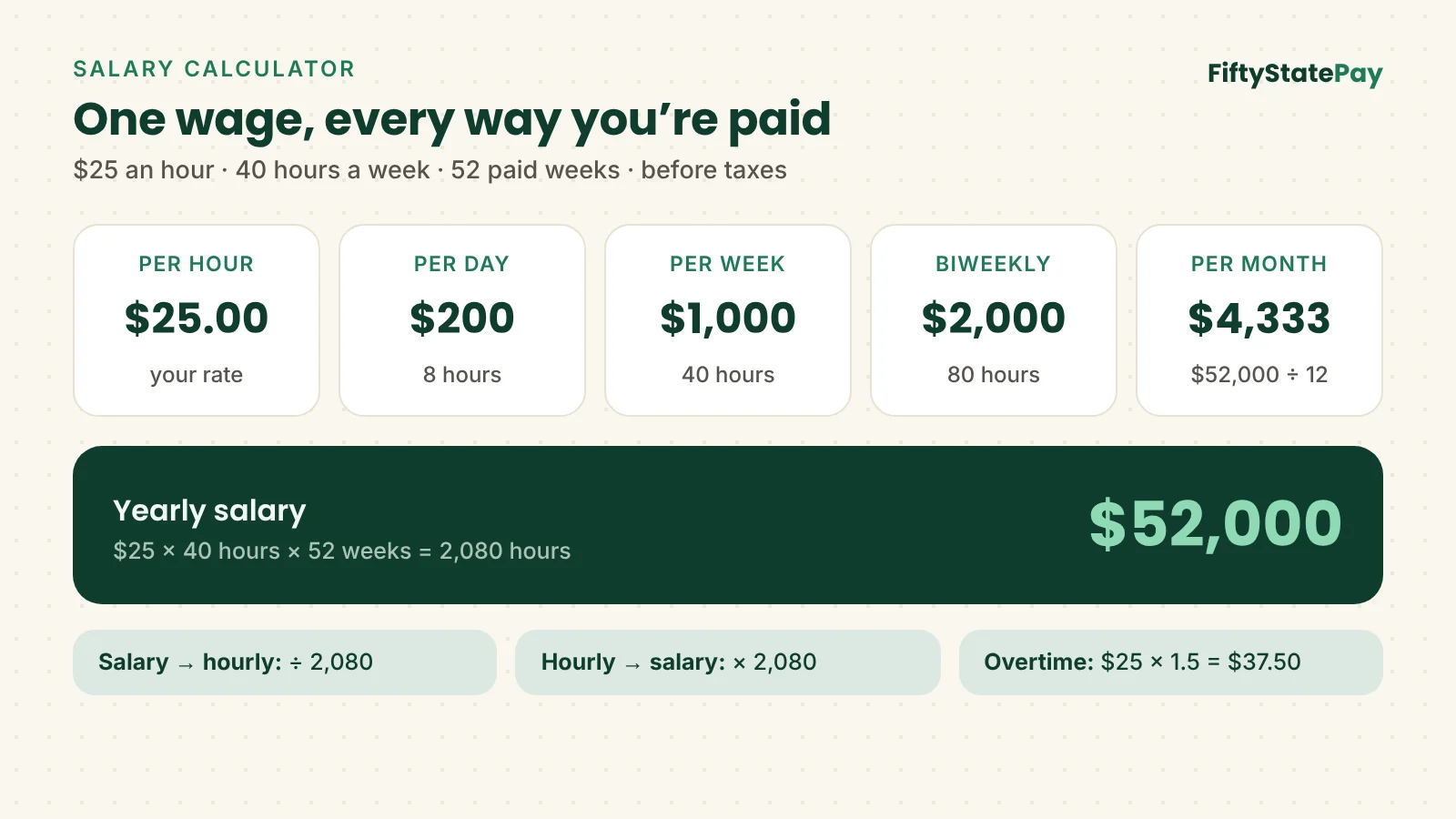
Here are the formulas the calculator uses. You can also use them by hand:
- Hourly rate = yearly salary ÷ (hours per week × paid weeks per year)
- Yearly salary = hourly rate × hours per week × paid weeks per year
- Weekly pay = yearly salary ÷ 52
- Biweekly pay = yearly salary ÷ 26
- Semimonthly pay = yearly salary ÷ 24
- Monthly pay = yearly salary ÷ 12
If you work 37.5 hours a week, or you take unpaid weeks off, change those boxes in the calculator. For example, a $60,000 salary at 37.5 hours a week is $30.77 an hour, not $28.85.
Salary to Hourly Calculator: Conversion Table
Quick answer
To convert salary to hourly pay, divide your yearly salary by 2,080. For example, $40,000 a year is $19.23 an hour, $50,000 is $24.04, $60,000 is $28.85, $75,000 is $36.06, and $100,000 is $48.08. These figures assume 40 hours a week and are before taxes.
| Yearly salary | Hourly | Weekly | Biweekly | Semimonthly | Monthly |
|---|---|---|---|---|---|
| $30,000 | $14.42 | $576.92 | $1,153.85 | $1,250.00 | $2,500.00 |
| $40,000 | $19.23 | $769.23 | $1,538.46 | $1,666.67 | $3,333.33 |
| $50,000 | $24.04 | $961.54 | $1,923.08 | $2,083.33 | $4,166.67 |
| $60,000 | $28.85 | $1,153.85 | $2,307.69 | $2,500.00 | $5,000.00 |
| $70,000 | $33.65 | $1,346.15 | $2,692.31 | $2,916.67 | $5,833.33 |
| $75,000 | $36.06 | $1,442.31 | $2,884.62 | $3,125.00 | $6,250.00 |
| $80,000 | $38.46 | $1,538.46 | $3,076.92 | $3,333.33 | $6,666.67 |
| $100,000 | $48.08 | $1,923.08 | $3,846.15 | $4,166.67 | $8,333.33 |
| $120,000 | $57.69 | $2,307.69 | $4,615.38 | $5,000.00 | $10,000.00 |
| $150,000 | $72.12 | $2,884.62 | $5,769.23 | $6,250.00 | $12,500.00 |
Note: 40 hours a week and 52 paid weeks (2,080 hours). Rounded to the cent.
Hourly to Salary Calculator: Conversion Table
Quick answer
To convert an hourly wage to a yearly salary, multiply it by 2,080. For example, $15 an hour is $31,200 a year, $20 is $41,600, $25 is $52,000, $30 is $62,400, and $50 is $104,000. If you work fewer hours or take unpaid time off, your yearly pay will be lower.
| Hourly wage | Weekly (40 hrs) | Biweekly | Monthly | Yearly | Overtime rate (1.5×) |
|---|---|---|---|---|---|
| $7.25 | $290.00 | $580.00 | $1,256.67 | $15,080 | $10.88 |
| $15.00 | $600.00 | $1,200.00 | $2,600.00 | $31,200 | $22.50 |
| $17.00 | $680.00 | $1,360.00 | $2,946.67 | $35,360 | $25.50 |
| $20.00 | $800.00 | $1,600.00 | $3,466.67 | $41,600 | $30.00 |
| $22.00 | $880.00 | $1,760.00 | $3,813.33 | $45,760 | $33.00 |
| $25.00 | $1,000.00 | $2,000.00 | $4,333.33 | $52,000 | $37.50 |
| $30.00 | $1,200.00 | $2,400.00 | $5,200.00 | $62,400 | $45.00 |
| $35.00 | $1,400.00 | $2,800.00 | $6,066.67 | $72,800 | $52.50 |
| $40.00 | $1,600.00 | $3,200.00 | $6,933.33 | $83,200 | $60.00 |
| $50.00 | $2,000.00 | $4,000.00 | $8,666.67 | $104,000 | $75.00 |
Note: $7.25 is the federal minimum wage. Many states and cities set a higher minimum. Monthly pay is yearly pay ÷ 12.
Want the reverse with taxes included? The hourly to salary calculator adds your state, so you see both gross and take-home pay.
Salary and Hourly Paycheck Calculators
Quick answer
A salary converter shows gross pay, while a paycheck calculator shows take-home pay after taxes. For example, a single worker paid $25 an hour for 40 hours a week keeps about $845 a week in Texas in 2026. That’s after federal income tax, Social Security, and Medicare, with no state tax.
Use the salary paycheck calculator if you’re paid a yearly amount. Use the hourly paycheck calculator if you’re paid by the hour, especially when your hours or overtime change from week to week.
Both tools handle the details that change your check:
- Your W-4 filing status, Step 2 checkbox, and dependents.
- Your state’s withholding form, plus city or county taxes.
- Pre-tax deductions, such as a 401(k), health insurance, HSA, or FSA.
- Pay frequency, from weekly to monthly.
Overtime Calculator: Time and a Half and Double Time
Quick answer
Under federal law, non-exempt employees earn at least 1.5 times their regular rate for every hour over 40 in a workweek. To figure it, multiply your hourly rate by 1.5, then by your overtime hours. For example, 5 overtime hours at $25 an hour pay $187.50, on top of $1,000 for the first 40 hours.
That same $1,187.50 week leaves a single filer in Texas with about $996 after taxes. Overtime is taxed like regular pay, so it can push a paycheck into a higher withholding bracket. However, that doesn’t change your final tax rate on the rest of your pay.
| Hours in the week | Regular pay | Overtime pay (1.5×) | Total pay |
|---|---|---|---|
| 40 | $1,000.00 | $0.00 | $1,000.00 |
| 45 | $1,000.00 | $187.50 | $1,187.50 |
| 50 | $1,000.00 | $375.00 | $1,375.00 |
| 60 | $1,000.00 | $750.00 | $1,750.00 |
States with daily overtime
Federal law only counts hours over 40 in a week, yet a few states go further:
- California: 1.5× after 8 hours in a day and 2× (double time) after 12 hours. Special rules also apply on the seventh day in a row.
- Alaska: 1.5× after 8 hours in a day, for most employers with four or more workers.
- Colorado: 1.5× after 12 hours in a day or 12 hours in a row.
- Nevada: 1.5× after 8 hours in a 24-hour period for workers earning less than 1.5 times the state minimum wage.
Who doesn’t get overtime?
Some salaried workers are exempt from overtime under the Fair Labor Standards Act. To be exempt, a job usually must meet both a salary test and a duties test, such as executive, administrative, or professional work. A job title alone doesn’t decide it. The U.S. Department of Labor explains the current tests.
Try the overtime calculator for weekly totals, or the time and a half calculator for a quick overtime rate.
No Tax on Overtime Calculator
Quick answer
For 2025 through 2028, you can deduct qualified overtime pay on your federal tax return. The deduction covers only the extra “half” of time and a half, up to $12,500 a year, or $25,000 for joint filers. It phases out above $150,000 of income ($300,000 joint) and doesn’t reduce Social Security, Medicare, or most state taxes.
Here’s an example. You earn $25 an hour and work 5 overtime hours a week for 50 weeks. Your overtime premium is $12.50 an hour, so your deduction is $3,125 for the year. At a 12% federal bracket, that saves you about $375 in federal income tax.
The deduction is claimed on your tax return, so it won’t show up on each paycheck by default. If you want the savings sooner, you can lower your withholding in Step 4(b) of your Form W-4. Our no tax on overtime calculator estimates both the deduction and the tax you save.
Bonus Tax Calculator
Quick answer
Most employers withhold a flat 22% federal income tax from a bonus, plus 6.2% for Social Security and 1.45% for Medicare. Bonuses over $1 million in a year face 37% federal withholding. State tax comes on top, so a $5,000 bonus can shrink to about $2,900 to $3,500 after withholding, depending on your state.
| Line | Texas | California | New York |
|---|---|---|---|
| Bonus | $5,000.00 | $5,000.00 | $5,000.00 |
| Federal income tax (22%) | −$1,100.00 | −$1,100.00 | −$1,100.00 |
| Social Security (6.2%) | −$310.00 | −$310.00 | −$310.00 |
| Medicare (1.45%) | −$72.50 | −$72.50 | −$72.50 |
| State income tax | $0.00 | −$511.50 (10.23%) | −$585.00 (11.70%) |
| State payroll premiums | $0.00 | −$65.00 (SDI) | −$21.60 (PFL) |
| Take-home bonus | $3,517.50 | $2,941.00 | $2,910.90 |
Note: Flat-rate method, employee outside New York City, Social Security wage base not yet reached.
Remember, withholding isn’t your final tax. If 22% is more than your real federal rate, you’ll get the difference back when you file. Some employers also use the aggregate method, which adds the bonus to a regular paycheck. The bonus tax calculator shows both methods for your state.
Pay Raise Calculator: Your New Salary
Quick answer
To find your new salary, multiply your current pay by one plus the raise percentage. A 3% raise on $60,000 adds $1,800, for a new salary of $61,800. After 2026 taxes, a single filer in Texas keeps about $1,446 of that raise, or $55.63 more per paycheck when paid every two weeks.
Taxes take a bigger bite in some states. For instance, the same 3% raise adds about $1,304 a year to take-home pay in California and about $1,341 in New York. The pay raise calculator shows the result for your own salary and state.
To find the percentage of a raise you’ve been offered, use this formula: (new pay − old pay) ÷ old pay × 100. So, moving from $25 to $26.50 an hour is a 6% raise.
PTO Accrual Calculator
Quick answer
To figure PTO accrual per paycheck, divide your yearly PTO hours by your number of paychecks. For example, 15 days of PTO is 120 hours. Paid every two weeks, you earn about 4.62 hours per paycheck. Hourly workers often accrue per hour worked instead, such as 0.0577 hours for each hour.
Federal law doesn’t require paid vacation, so PTO depends on your employer’s policy. However, many states and cities require paid sick leave, including California, New York, and Washington. A few states, such as California, Colorado, and Massachusetts, also require employers to pay out earned, unused vacation when you leave.
Use the PTO accrual calculator to see how fast your balance grows and what your PTO is worth in dollars.
Federal Income Tax Calculator
Quick answer
Your 2026 federal income tax starts with your income minus the standard deduction, which is $16,100 for single filers. The brackets then tax each slice at 10% to 37%. For example, a single filer earning $60,000 has $43,900 of taxable income and owes about $5,020, or 8.4% of pay, before credits.
| Step | How it’s figured | Amount |
|---|---|---|
| Salary | Gross wages | $60,000 |
| Standard deduction | Single filer, 2026 | −$16,100 |
| Taxable income | $60,000 − $16,100 | $43,900 |
| 10% bracket | 10% × $12,400 | $1,240 |
| 12% bracket | 12% × ($43,900 − $12,400) | $3,780 |
| Federal income tax | $1,240 + $3,780 | $5,020 |
The federal income tax calculator adds credits, other income, and what you’ve had withheld. It then tells you whether to expect a refund or a balance due.
Which Salary or Pay Calculator Should You Use?
| Your question | Best tool |
|---|---|
| How much will I take home from my salary? | Salary paycheck calculator |
| How much will I take home from my hourly job? | Hourly paycheck calculator |
| What is my salary as an hourly wage? | Salary to hourly calculator |
| What is my hourly wage as a yearly salary? | Hourly to salary calculator |
| How much will my overtime pay? | Overtime calculator |
| Will I save tax on my overtime? | No tax on overtime calculator |
| How much of my bonus will I keep? | Bonus tax calculator |
| Is this raise worth it? | Pay raise calculator |
| How much PTO will I earn? | PTO accrual calculator |
| Will I get a refund this year? | Federal income tax calculator |
How Our Pay Tools Calculate
All eleven tools share one tax engine. It follows IRS Publication 15-T for 2026, the Social Security wage base from the SSA, and each state’s own withholding formula. We test it against worked examples that state tax agencies publish, and we update it when laws change.
Official rules
IRS, SSA, Department of Labor, and state tax agency sources.
One engine
Every tool gives the same answer as our paycheck calculator.
Private
Your numbers stay in your browser and are never stored.
Read more on our how we calculate and tax data sources pages.
Estimates, not tax advice
These tools estimate pay and withholding using 2026 rules. Your employer’s payroll system, benefits, and final tax return can differ. For advice about your own situation, talk to a tax professional.
Salary Calculator FAQs
How do I convert my salary to an hourly wage?
Divide your yearly salary by the hours you work in a year. For a full-time job, that’s 2,080 hours (40 hours × 52 weeks). For example, $50,000 ÷ 2,080 = $24.04 an hour. The salary calculator at the top of this page does it for you.
How many work hours are in a year?
A full-time year has 2,080 work hours, based on 40 hours a week for 52 weeks. That count includes paid holidays and vacation. If you work 37.5 hours a week, it’s 1,950 hours.
How much is $60,000 a year per hour?
At 40 hours a week, $60,000 a year is $28.85 an hour before taxes. It’s also $1,153.85 a week, $2,307.69 every two weeks, and $5,000 a month.
How much is $25 an hour per year?
At 40 hours a week for 52 weeks, $25 an hour is $52,000 a year before taxes. That’s $1,000 a week and about $4,333 a month. A single filer in Texas keeps about $845 a week after 2026 taxes.
How is overtime pay calculated?
Multiply your regular hourly rate by 1.5 to get your overtime rate, then multiply by your overtime hours. Federal law requires this for hours over 40 in a workweek. Some states, such as California, also require daily overtime and double time.
Why is my bonus taxed so high?
Bonuses are usually withheld at a flat 22% federal rate, plus Social Security, Medicare, and state tax. That withholding can be higher than your real tax rate. If so, the extra comes back as a refund when you file.
How much of a raise will I actually keep?
Usually about 60% to 80% of it, depending on your state and tax bracket. For example, a single filer in Texas keeps about $1,446 of a $1,800 raise in 2026. Use the pay raise calculator for your own numbers.
Do I get paid for unused PTO when I leave a job?
It depends on your state and your employer’s policy. California, Colorado, and Massachusetts, among others, require employers to pay out earned, unused vacation. In many other states, the company policy decides.
The Bottom Line
A salary calculator answers the first question about any job offer: what does this pay per hour, per week, and per year? Our free pay tools then take you further, with overtime, bonuses, raises, PTO, and take-home pay, all using 2026 tax rules for your state.
Sources
- Overtime payU.S. Department of Labor Official
- Fact Sheet #23: Overtime Pay Requirements of the FLSAU.S. Department of Labor Official
- One Big Beautiful Bill: no tax on tips and overtimeInternal Revenue Service Official
- Publication 15 (2026), Employer’s Tax Guide: supplemental wagesInternal Revenue Service Official
- IRS Publication 15-T (2026), Federal Income Tax Withholding MethodsInternal Revenue Service Official
- IRS releases tax inflation adjustments for tax year 2026Internal Revenue Service Official
- California overtimeCalifornia Department of Industrial Relations Official
Note: This page is general information, not tax, legal, or financial advice.
See what your pay is really worth
Convert your salary, then check your 2026 take-home pay in your state.