

Method · 2026 tax year · Updated when the rules change
How We Calculate Your Paycheck in 2026: Our Method, Step by Step
This page shows how we calculate your paycheck. Every FiftyStatePay result follows the same six steps, from gross pay to take-home pay, and each step uses an official IRS or state rule.
You will see the order of the math, a worked example, how we test the results, and what an estimate cannot include. Nothing here is a black box.
- IRS Publication 15-T percentage method
- Each state’s own withholding formula
- Tested against official examples
- Limits stated openly
Last updated October 21, 2026 · By Hamza Akram · Contact us
How We Calculate Your Paycheck in Six Steps
Quick answer
We calculate your paycheck in six steps. First we convert your pay to a per-paycheck amount. Then we subtract pre-tax deductions, figure federal withholding with IRS Publication 15-T, add Social Security and Medicare, apply your state and local rules, and subtract after-tax items. What remains is your net pay.
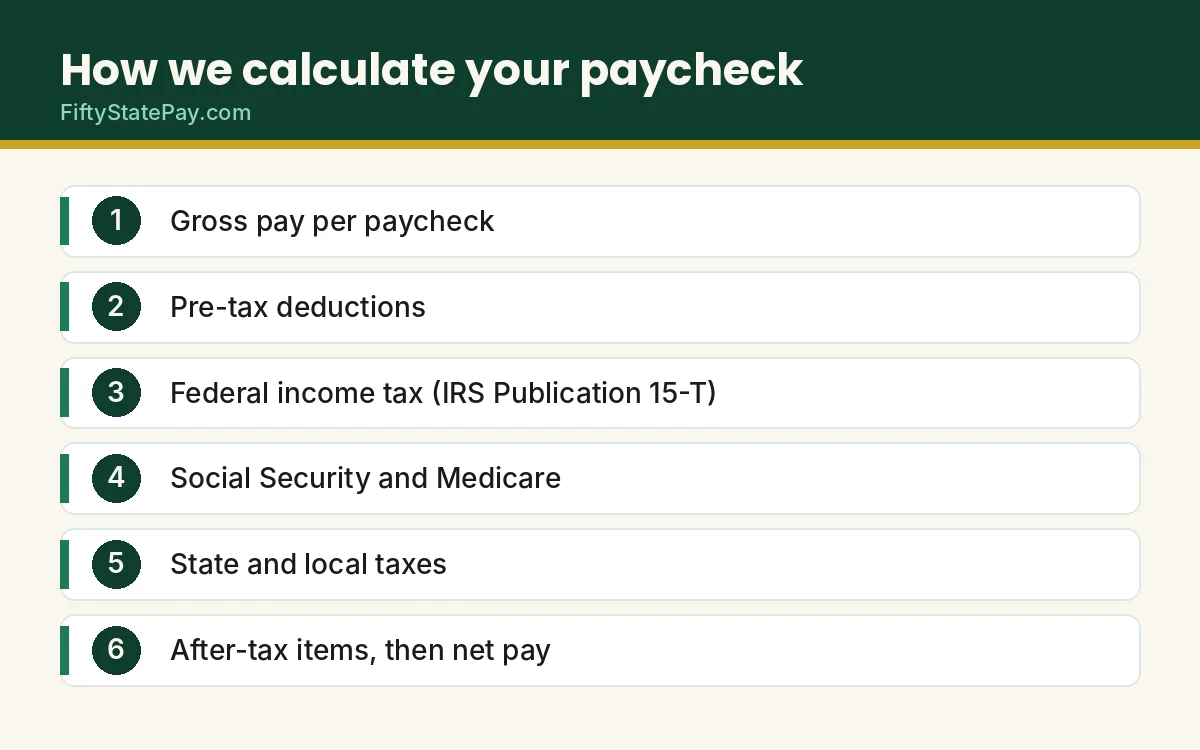
Gross pay per paycheck.
Salary divided by your pay periods, or hourly rate times hours, plus overtime at 1.5× or 2×.
Pre-tax deductions.
A traditional 401(k), health premiums, HSA and FSA come out before taxes, and each one lowers only the taxes the law allows.
Federal income tax.
We apply the IRS percentage method from Publication 15-T, using your W-4 answers.
Social Security and Medicare.
6.2% up to the wage base, 1.45% on all wages, plus 0.9% above $200,000.
State and local taxes.
Your state’s withholding formula, any city or county tax, and state payroll premiums such as disability or paid leave.
After-tax deductions and net pay.
Roth 401(k) contributions and other after-tax items come out last. The rest is your take-home pay.
A Worked Example: $60,000 in California
Here is the method on a real 2026 paycheck. The worker earns $60,000 in California, is single, and is paid every two weeks. She puts 5% into a traditional 401(k) and pays $75 per check for health insurance.
Biweekly pay stub: $60,000 salary in California (2026)
Earnings
- Gross pay$60,000 ÷ 26 paychecks
- $2,307.69
Pre-tax deductions
- 401(k)5% of gross pay
- −$115.38
- Health insuranceSection 125 plan
- −$75.00
Taxes
- Federal income taxIRS percentage method, single
- −$170.23
- Social Security6.2% of $2,232.69
- −$138.43
- Medicare1.45% of $2,232.69
- −$32.37
- California income taxForm DE 4, single, 1 allowance
- −$56.80
- California SDI1.3% of $2,232.69
- −$29.03
- Net paydeposited on payday
- $1,690.45
Notice that Social Security is figured on $2,232.69, not on gross pay. Health insurance through a cafeteria plan is free of FICA tax, so it lowers that base. The 401(k), however, still counts for Social Security and Medicare.
How We Calculate Federal Income Tax
Quick answer
We figure federal income tax withholding with Worksheet 1A of IRS Publication 15-T, the percentage method for automated payroll. It annualizes your pay, adjusts it for your W-4, applies the 2026 tax brackets for your filing status, and divides the result back into one paycheck.
The calculator reads the same W-4 choices your employer uses. For the current form, that means your filing status, the Step 2 checkbox for other jobs, the Step 3 credits ($2,200 per child under 17 and $500 per other dependent), and Step 4 adjustments. It also supports the older pre-2020 W-4, which counts allowances at $4,300 each.
Because this is withholding, it estimates what an employer takes from each check. It is not your final tax bill, which you settle on your tax return.
How We Calculate Social Security and Medicare
Social Security tax is 6.2% of wages up to the 2026 wage base of $184,500. Medicare tax is 1.45% of all wages, with an extra 0.9% on wages above $200,000. Together, these make up FICA.
We simulate the whole year paycheck by paycheck, so the Social Security cap lands in the right check. As a result, high earners see the raise in take-home pay once they pass the wage base.
How We Calculate State and Local Taxes
Each state sets its own rules. Nine states do not tax wages: Alaska, Florida, Nevada, New Hampshire, South Dakota, Tennessee, Texas, Washington and Wyoming. For the other 41 states and DC, we use that state’s published withholding formula, its withholding certificate, and its rounding rules.
Local taxes come next. We cover New York City and Yonkers, Maryland counties, Indiana counties, Philadelphia and other Pennsylvania cities, Ohio and Kentucky cities, and more. State payroll programs follow, such as California SDI, New York paid family leave and Washington paid leave.
When a state changes its law mid-year, we update the data and record it in the tax updates log.
How We Calculate Bonuses and Overtime
Overtime pay is hours over 40 in a week times 1.5, or times 2 where you choose double time. For bonuses, our tool uses the flat-rate method where a state publishes one, and the aggregate method otherwise. Both are IRS-recognized ways to withhold on supplemental pay.
How We Test Our Paycheck Calculations
A formula is only useful if it matches reality. So we test in three ways.
- Official examples: every worked example we could find from state agencies passes, including Alabama, Arkansas, California, New York, Iowa, South Carolina, Kentucky, Minnesota, Illinois and North Dakota.
- Consistency checks: about 15,000 automated checks across all 51 jurisdictions, such as “more pay never lowers net pay.”
- A second version: a separate build of the federal formula and 12 state formulas, compared on 5,200 random cases.
What Our Estimates Do Not Include
No online tool can see your employer’s payroll system. That is why a real paycheck can differ from any estimate.
| Cause | What it means | What to do |
|---|---|---|
| Employer settings | Your employer may round differently or use a different pay calendar. | Compare against your latest pay stub. |
| Benefits and perks | Some benefits are taxed in unusual ways, such as group term life over $50,000. | Enter them as deductions where we offer a field. |
| Garnishments and loans | Court orders and 401(k) loan repayments come out of net pay. | Subtract them from the estimate. |
| Multi-state work | Nonresident and reciprocity rules are not modeled. | Ask payroll which state is withholding. |
| Unlisted local taxes | We cover many cities, but not every local tax. | Use the custom local rate field where offered. |
| Tips and overtime deductions | These are not in withholding unless entered in W-4 Step 4(b). | Adjust your W-4 if you qualify. |
Read our disclaimer for the full list of limits.
What Happens to the Numbers You Type
The calculator runs in your browser, and the figures you type are not sent to our server. If your browser allows it, the calculator remembers your last entries on your own device so you can come back to them. A reset button clears them. See the privacy policy for more.
Frequently Asked Questions
How is a paycheck calculated?
Your employer starts with gross pay, subtracts pre-tax deductions, figures federal, Social Security, Medicare, state and local taxes, then subtracts after-tax items. What is left is net pay. Our calculator follows the same order.
Which IRS method do you use for federal withholding?
We use the percentage method in Worksheet 1A of IRS Publication 15-T, which is the method for automated payroll systems. It takes the details from your Form W-4.
Why is my real paycheck different from the calculator?
Usually because of employer settings, benefits, garnishments or a local tax we do not list. Compare each line of your pay stub with the estimate to find the gap.
Does the calculator use my W-4?
Yes. It asks for the same choices as the current W-4, including filing status, other jobs, dependents and extra withholding. It also supports the older pre-2020 form.
How are bonuses taxed on a paycheck?
Bonuses are supplemental pay. Employers use either a flat percentage or the aggregate method. Our bonus tool lets you compare, and it applies the state’s own flat rate where one exists.
How accurate is a paycheck calculator?
It is an estimate. Ours uses official 2026 formulas and passes every state worked example we found, so results are usually close. Only your employer’s payroll can give the exact amount.
What does the calculator not include?
It does not model multi-state allocation, reciprocity agreements, some local taxes, or employer-specific benefits. The table above lists each limit.
Estimates, not tax advice
Results are estimates for general information. They are not tax, legal or financial advice. Your employer’s payroll sets your real withholding, so check your pay stub and ask a tax professional about your own situation.
Sources
- IRS Publication 15-T (2026), Federal Income Tax Withholding MethodsInternal Revenue Service Official
- IRS Publication 15 (Circular E), Employer’s Tax GuideInternal Revenue Service Official
- IRS Tax Withholding EstimatorInternal Revenue Service Official
- Contribution and Benefit BaseSocial Security Administration Official
Check the method on your own paycheck
Now you know how we calculate. Enter your pay and compare each line with your latest pay stub.