

All 50 states + DC · 2026 tax year
Paycheck Calculator by State: 2026 Tax Rates and Take-Home Pay
Use this paycheck calculator by state to see your 2026 take-home pay. Choose your state below to open a free calculator built on that state’s own withholding rules. Each one shows your pay after federal, state, and local taxes, so you know exactly what lands in your bank account.
Below the state list, you’ll find every state’s 2026 income tax rate in one table. You’ll also see which states don’t tax wages, which use a flat tax, and which add city taxes or payroll premiums.
- Each state’s official 2026 withholding formula
- Federal tax per IRS Publication 15-T
- Rates checked against state tax agencies
- Free, no sign-up, nothing stored
Last updated October 2026 · Uses 2026 tax rules in force October 2026 (data 2026.10.1) · How we calculate
Choose Your State Paycheck Calculator
Quick answer
A state paycheck calculator turns your gross pay into take-home pay using your state’s own tax rules. It applies federal income tax, Social Security, Medicare, state income tax, local taxes, and state payroll premiums. Pick your state below, enter your pay, and you’ll see your net pay per paycheck and per year.
- ALAlabamaComing soon
- AKAlaskaNo income taxComing soon
- AZArizonaComing soon
- ARArkansasComing soon
- CACaliforniaComing soon
- COColoradoComing soon
- CTConnecticutComing soon
- DEDelawareComing soon
- DCDistrict of ColumbiaComing soon
- FLFloridaNo income taxComing soon
- GAGeorgiaComing soon
- HIHawaiiComing soon
- IDIdahoComing soon
- ILIllinoisComing soon
- INIndianaComing soon
- IAIowaComing soon
- KSKansasComing soon
- KYKentuckyComing soon
- LALouisianaComing soon
- MEMaineComing soon
- MDMarylandComing soon
- MAMassachusettsComing soon
- MIMichiganComing soon
- MNMinnesotaComing soon
- MSMississippiComing soon
- MOMissouriComing soon
- MTMontanaComing soon
- NENebraskaComing soon
- NVNevadaNo income taxComing soon
- NHNew HampshireNo income taxComing soon
- NJNew JerseyComing soon
- NMNew MexicoComing soon
- NYNew YorkComing soon
- NCNorth CarolinaComing soon
- NDNorth DakotaComing soon
- OHOhioComing soon
- OKOklahomaComing soon
- OROregonComing soon
- PAPennsylvaniaComing soon
- RIRhode IslandComing soon
- SCSouth CarolinaComing soon
- SDSouth DakotaNo income taxComing soon
- TNTennesseeNo income taxComing soon
- TXTexasNo income taxComing soon
- UTUtahComing soon
- VTVermontComing soon
- VAVirginiaComing soon
- WAWashingtonNo income taxComing soon
- WVWest VirginiaComing soon
- WIWisconsinComing soon
- WYWyomingNo income taxComing soon
Every state page uses the same trusted engine, yet each one knows its own state’s details. For example, each calculator:
- Opens on the right state, with its 2026 withholding formula already loaded.
- Asks for the questions on that state’s own withholding form, such as allowances or exemptions.
- Adds local taxes where they apply, like New York City, Maryland counties, or Ohio cities.
- Includes state payroll premiums, such as California SDI or Washington’s paid leave premium.
- Lets you download a PDF pay stub, compare states, or share your results.
Why Your State Changes Your Paycheck
Quick answer
Your state decides three things on your paycheck: whether it taxes wages, how much it withholds, and which local taxes or payroll premiums apply. As a result, the same $60,000 salary can leave you with $50,390 in Texas but $45,996 in Oregon in 2026. That’s a gap of $4,394 a year.
9
States that don’t tax wages
AK, FL, NV, NH, SD, TN, TX, WA, WY
15
States with a flat income tax
from 2.5% to 5.3%
27
Graduated systems
26 states plus DC
13.3%
Highest top rate
California, on income over $1 million
Federal taxes work the same way everywhere. Federal income tax, Social Security (6.2%), and Medicare (1.45%) follow one set of IRS rules in all 50 states. By contrast, state taxes vary a lot from one state line to the next.
Four state-level factors change what you take home:
- State income tax. Some states charge nothing on wages, others use one flat rate, and the rest use brackets that rise with income.
- State withholding rules. Each state has its own formula, deductions, and allowances. So, two states with similar rates can still withhold different amounts.
- Local income taxes. Cities, counties, and school districts in about a dozen states add their own tax on wages.
- State payroll programs. Sixteen states take small deductions for disability insurance, paid leave, unemployment, or long-term care.
That’s why a paycheck calculator by state gives you a truer number than any national average.
2026 State Income Tax Rates for All 50 States
Quick answer
In 2026, state income tax rates on wages range from 0% in nine states to a top rate of 13.3% in California. Fifteen states use a single flat rate, while 26 states and DC use graduated brackets. The table below lists every state’s 2026 rates, local wage taxes, and employee payroll premiums.
| Alabama | Graduated | 2%–5% | Some cities and counties | None |
|---|---|---|---|---|
| Alaska | No income tax | None | None | Unemployment 0.5% (first $54,200) |
| Arizona | Flat | 2.5% | None | None |
| Arkansas | Graduated | 2%–3.7% | None | None |
| California | Graduated | 1%–13.3% | None | SDI 1.3% |
| Colorado | Flat | 4.4% | Monthly fee in a few cities (Denver $5.75) | FAMLI paid leave 0.44% |
| Connecticut | Graduated | 2%–6.99% | None | Paid Leave 0.5% |
| Delaware | Graduated | 2.2%–6.6% | Wilmington 1.25% | Paid leave up to 0.4% |
| District of Columbia | Graduated | 4%–10.75% | None | None |
| Florida | No income tax | None | None | None |
| Georgia | Flat | 4.99% | None | None |
| Hawaii | Graduated | 1.4%–11% | None | TDI up to 0.5% |
| Idaho | Flat | 5.3% | None | None |
| Illinois | Flat | 4.95% | None | None |
| Indiana | Flat | 2.95% | All 92 counties | None |
| Iowa | Flat | 3.8% | School district surtax (paid with your return) | None |
| Kansas | Graduated | 5.2%–5.58% | None | None |
| Kentucky | Flat | 3.5% | Most cities and counties | None |
| Louisiana | Flat | 3% | None | None |
| Maine | Graduated | 5.8%–7.15% (plus 2% over $1 million) | None | Paid leave up to 0.5% |
| Maryland | Graduated | 2%–6.5% | Every county and Baltimore City | None |
| Massachusetts | Graduated | 5% (9% over $1,107,750) | None | PFML 0.46% |
| Michigan | Flat | 4.25% | 24 cities (Detroit 2.4%) | None |
| Minnesota | Graduated | 5.35%–9.85% | None | Paid Leave up to 0.44% |
| Mississippi | Flat | 4% (above $10,000) | None | None |
| Missouri | Graduated | 2%–4.7% | Kansas City and St. Louis 1% | None |
| Montana | Graduated | 4.7%–5.65% | None | None |
| Nebraska | Graduated | 2.46%–4.55% | None | None |
| Nevada | No income tax | None | None | None |
| New Hampshire | No income tax | None | None | None |
| New Jersey | Graduated | 1.4%–10.75% | None | UI/WF 0.425%, TDI 0.19%, FLI 0.23% |
| New Mexico | Graduated | 1.5%–5.9% | None | None |
| New York | Graduated | 3.9%–10.9% | New York City and Yonkers | PFL 0.432%, SDI up to $0.60 a week |
| North Carolina | Flat | 3.99% | None | None |
| North Dakota | Graduated | 1.95%–2.5% | None | None |
| Ohio | Flat | 2.75% | Most cities, some school districts | None |
| Oklahoma | Graduated | 2.5%–4.5% | None | None |
| Oregon | Graduated | 4.75%–9.9% | Portland-area taxes on higher incomes | Paid Leave 0.6%, transit tax 0.1% |
| Pennsylvania | Flat | 3.07% | Nearly every municipality | Unemployment 0.07% |
| Rhode Island | Graduated | 3.75%–5.99% | None | TDI 1.1% (first $100,000) |
| South Carolina | Graduated | 1.99%–5.21% | None | None |
| South Dakota | No income tax | None | None | None |
| Tennessee | No income tax | None | None | None |
| Texas | No income tax | None | None | None |
| Utah | Flat | 4.45% | None | None |
| Vermont | Graduated | 3.35%–8.75% | None | Child care 0.11% |
| Virginia | Graduated | 2%–5.75% | None | None |
| Washington | No income tax | None on wages | None | Paid leave 0.81%, WA Cares 0.58% |
| West Virginia | Graduated | 2.11%–4.58% | None | None |
| Wisconsin | Graduated | 3.5%–7.65% | None | None |
| Wyoming | No income tax | None | None | None |
Note: Statutory rates for wages in tax year 2026, including laws passed during 2026. Many states also have a 0% bracket or a standard deduction before the first rate applies. Withholding tables can differ slightly from these rates. Washington taxes some capital gains, not wages.
These are statutory rates, which your state uses to figure your final tax on your return. Your paycheck, however, is based on withholding tables, which estimate that tax over the year. For instance, New Jersey’s withholding tables reach 11.8%, and Ohio’s run from 1.6% to 3.4% for wages paid from August 1, 2026. Our paycheck calculator for each state uses the withholding tables, so your estimate matches your real paycheck.
States With No Income Tax on Wages
Quick answer
Nine states don’t tax wages in 2026: Alaska, Florida, Nevada, New Hampshire, South Dakota, Tennessee, Texas, Washington, and Wyoming. Workers there still pay federal income tax, Social Security, and Medicare. However, Washington withholds paid leave and long-term care premiums, and Alaska withholds 0.5% for unemployment insurance.
Texas
Federal taxes only: no state income tax or payroll premiums.
Florida
Only federal income tax, Social Security, and Medicare apply.
Alaska
0.5% unemployment insurance on the first $54,200 of wages.
Washington
Paid leave (0.81%) and WA Cares (0.58%) premiums apply.
New Hampshire
Ended its tax on interest and dividends in 2025.
Nevada
Wages are free of state income tax and payroll premiums.
Tennessee
Its old tax on investment income ended in 2021, too.
South Dakota
State tax on paychecks is zero, with no payroll premiums.
Wyoming
Payroll stays simple: federal withholding and FICA only.
Does a no-tax state always mean a bigger paycheck?
Not always. States without an income tax still need revenue, so many of them lean more on sales, property, or business taxes. Your total tax bill, therefore, depends on what you buy, whether you own a home, and where you live. For a full picture, compare your take-home pay with your local housing costs and sales tax.
Our states with no income tax guide covers each state in more detail.
Flat Tax States in 2026
Quick answer
Fifteen states use a flat income tax in 2026, which means one rate applies to all taxable wages. Arizona has the lowest flat rate at 2.5%, and Idaho has the highest at 5.3%. Several flat-tax states, including Georgia, Indiana, Kentucky, North Carolina, and Utah, cut their rates again for 2026.
| Arizona | 2.5% | You choose 0.5% to 3.5% withholding on Form A-4 |
|---|---|---|
| Colorado | 4.4% | FAMLI paid leave premium of 0.44% |
| Georgia | 4.99% | Cut from 5.19%, retroactive to January 1 |
| Idaho | 5.3% | No withholding on the first $16,100 (single) |
| Illinois | 4.95% | No local income taxes |
| Indiana | 2.95% | Plus a county tax in all 92 counties |
| Iowa | 3.8% | School district surtax is paid with your return |
| Kentucky | 3.5% | Plus city and county occupational taxes |
| Louisiana | 3% | Withholding uses 3.09% |
| Michigan | 4.25% | Plus city tax in 24 cities |
| Mississippi | 4% | 0% on the first $10,000 of taxable income |
| North Carolina | 3.99% | Withholding uses 4.09% |
| Ohio | 2.75% | Withholding tables are graduated; most cities add a tax |
| Pennsylvania | 3.07% | 401(k) contributions are taxable for state tax |
| Utah | 4.45% | Cut from 4.5% for 2026 |
A flat tax makes paychecks easier to predict, since a raise is taxed at the same state rate as the rest of your pay. Still, local taxes can push the total well above the state rate. A Detroit resident, for example, pays Michigan’s 4.25% plus Detroit’s 2.4% city tax.
States With Graduated Income Tax Brackets
Quick answer
Twenty-six states and DC use graduated brackets, so the rate rises as income rises. In 2026, the highest top rates are California (13.3%), Hawaii (11%), New York (10.9%), New Jersey and DC (10.75%), Oregon (9.9%), and Minnesota (9.85%). North Dakota has the lowest top rate at 2.5%.
Graduated state taxes work just like the federal system. Only the part of your income inside each bracket is taxed at that bracket’s rate. So, a raise never lowers your take-home pay, even if part of it falls into a higher bracket.
| California | 13.3% | Income over $1 million (includes the 1% mental health tax) |
|---|---|---|
| Hawaii | 11% | High incomes |
| New York | 10.9% | Income over $25 million |
| New Jersey | 10.75% | Income over $1 million |
| District of Columbia | 10.75% | Income over $1 million |
| Oregon | 9.9% | Income over $125,000 (single) |
| Minnesota | 9.85% | High incomes |
| Maine | 9.15% | Income over $1 million (7.15% plus the 2% surtax) |
| Massachusetts | 9% | Income over $1,107,750 |
Note: Bracket start points adjust for inflation in many states. Each state paycheck calculator lists that state’s exact 2026 brackets.
Local Taxes on Your Paycheck, State by State
Quick answer
Cities, counties, or school districts in about a dozen states tax wages, too. The biggest examples are New York City, Philadelphia, Detroit, every Maryland county, all 92 Indiana counties, and most Ohio and Pennsylvania towns. Your employer usually withholds local tax based on where you live, where you work, or both.
| State | Who charges it | Example |
|---|---|---|
| Alabama | Some cities and counties | Birmingham occupational tax 1% |
| Colorado | A few cities, as a flat monthly fee | Denver $5.75 a month |
| Delaware | Wilmington | 1.25% earned income tax |
| Indiana | All 92 counties | Rate set by each county |
| Kentucky | Most cities and counties | Occupational license taxes |
| Maryland | Every county and Baltimore City | 2.25% to 3.3% |
| Michigan | 24 cities | Detroit 2.4% for residents |
| Missouri | Kansas City and St. Louis | 1% earnings tax |
| New York | New York City and Yonkers | NYC tax for residents |
| Ohio | Most cities and some school districts | Columbus 2.5% |
| Oregon | Portland-area governments | Metro and Multnomah County taxes on higher incomes |
| Pennsylvania | Nearly every municipality and school district | Philadelphia wage tax |
Note: Iowa’s school district surtax is figured on your state return, not withheld from most paychecks.
Local rules can be tricky. In Ohio and Pennsylvania, for example, you may owe tax to both the city where you work and the one where you live, with a credit for part of it. That’s why each state paycheck calculator lets you pick your city or county.
State Paycheck Deductions: SDI, Paid Leave and More
Quick answer
Sixteen states take small payroll deductions on top of income tax in 2026. These fund disability insurance, paid family and medical leave, unemployment insurance, child care, or long-term care. California SDI is the largest at 1.3% of all wages, followed by Washington at about 1.39% and Rhode Island at 1.1%.
These deductions show up on your pay stub with short labels, such as SDI, TDI, PFL, FLI, or FAMLI. They’re usually a small share of your pay, but they add up. For example, California SDI takes $780 a year from a $60,000 salary.
- Disability insurance: California (SDI 1.3%), Hawaii (TDI up to 0.5%), New Jersey (TDI 0.19%), New York (SDI up to $0.60 a week), and Rhode Island (TDI 1.1%).
- Paid family and medical leave: Colorado, Connecticut, Delaware, Maine, Massachusetts, Minnesota, New Jersey, New York, Oregon, and Washington.
- Unemployment insurance: Alaska, New Jersey, and Pennsylvania charge employees a small share.
- Other programs: Oregon’s 0.1% statewide transit tax, Vermont’s child care contribution, and Washington’s WA Cares long-term care premium.
Take-Home Paycheck by State on a $60,000 Salary
Quick answer
On a $60,000 salary in 2026, a single filer keeps $50,390 a year in Florida, Nevada, New Hampshire, South Dakota, Tennessee, Texas, and Wyoming. North Dakota comes close at $50,338. At the other end, the same worker keeps $47,057 in Hawaii and $45,996 in Oregon, before any local tax.
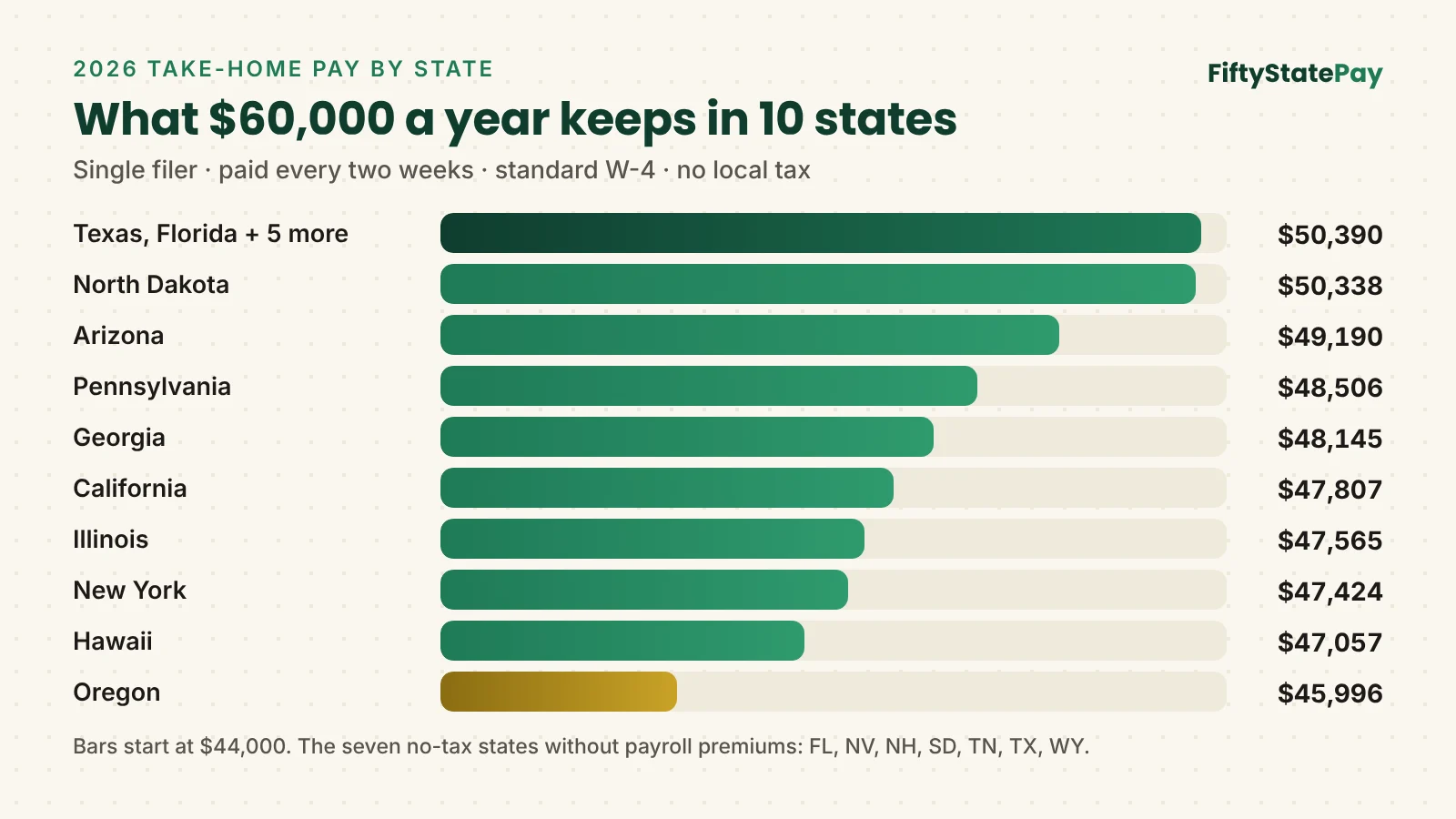
The table below uses the same engine as each state paycheck calculator. It ranks all 50 states and DC with identical pay and settings, and you can tap a column heading to sort it.
| # | State | State + local payroll taxes | Take-home a year | Per paycheck (biweekly) |
|---|---|---|---|---|
| 1 | Florida | $0 | $50,390 | $1,938.08 |
| 2 | Nevada | $0 | $50,390 | $1,938.08 |
| 3 | New Hampshire | $0 | $50,390 | $1,938.08 |
| 4 | South Dakota | $0 | $50,390 | $1,938.08 |
| 5 | Tennessee | $0 | $50,390 | $1,938.08 |
| 6 | Texas | $0 | $50,390 | $1,938.08 |
| 7 | Wyoming | $0 | $50,390 | $1,938.08 |
| 8 | North Dakota | $52 | $50,338 | $1,936.08 |
| 9 | Alaska | $271 | $50,119 | $1,927.65 |
| 10 | Washington | $832 | $49,558 | $1,906.06 |
| 11 | Arizona | $1,200 | $49,190 | $1,891.92 |
| 12 | Ohio | $1,412 | $48,978 | $1,883.75 |
| 13 | Louisiana | $1,456 | $48,934 | $1,882.07 |
| 14 | Mississippi | $1,664 | $48,726 | $1,874.08 |
| 15 | Arkansas | $1,733 | $48,657 | $1,871.42 |
| 16 | Indiana | $1,741 | $48,650 | $1,871.13 |
| 17 | Iowa | $1,746 | $48,644 | $1,870.92 |
| 18 | Vermont | $1,764 | $48,626 | $1,870.25 |
| 19 | Missouri | $1,872 | $48,518 | $1,866.08 |
| 20 | Pennsylvania | $1,884 | $48,506 | $1,865.62 |
| 21 | North Carolina | $1,924 | $48,466 | $1,864.08 |
| 22 | Kentucky | $1,982 | $48,408 | $1,861.83 |
| 23 | New Mexico | $2,033 | $48,357 | $1,859.90 |
| 24 | West Virginia | $2,054 | $48,336 | $1,859.08 |
| 25 | Montana | $2,063 | $48,327 | $1,858.72 |
| 26 | Nebraska | $2,124 | $48,266 | $1,856.37 |
| 27 | Oklahoma | $2,158 | $48,232 | $1,855.08 |
| 28 | Georgia | $2,246 | $48,145 | $1,851.71 |
| 29 | South Carolina | $2,284 | $48,106 | $1,850.23 |
| 30 | Michigan | $2,299 | $48,091 | $1,849.64 |
| 31 | Idaho | $2,314 | $48,076 | $1,849.08 |
| 32 | New Jersey | $2,396 | $47,994 | $1,845.91 |
| 33 | Alabama | $2,509 | $47,881 | $1,841.58 |
| 34 | Maryland | $2,537 | $47,854 | $1,840.52 |
| 35 | Kansas | $2,548 | $47,842 | $1,840.07 |
| 36 | California | $2,583 | $47,807 | $1,838.71 |
| 37 | Connecticut | $2,618 | $47,773 | $1,837.40 |
| 38 | Virginia | $2,636 | $47,754 | $1,836.70 |
| 39 | Colorado | $2,662 | $47,728 | $1,835.69 |
| 40 | Utah | $2,670 | $47,720 | $1,835.38 |
| 41 | Wisconsin | $2,765 | $47,625 | $1,831.75 |
| 42 | Illinois | $2,825 | $47,565 | $1,829.42 |
| 43 | Rhode Island | $2,873 | $47,518 | $1,827.60 |
| 44 | Maine | $2,874 | $47,516 | $1,827.54 |
| 45 | Delaware | $2,893 | $47,497 | $1,826.80 |
| 46 | Massachusetts | $2,956 | $47,434 | $1,824.38 |
| 47 | New York | $2,966 | $47,424 | $1,823.99 |
| 48 | Minnesota | $3,181 | $47,209 | $1,815.73 |
| 49 | District of Columbia | $3,230 | $47,160 | $1,813.84 |
| 50 | Hawaii | $3,333 | $47,057 | $1,809.87 |
| 51 | Oregon | $4,394 | $45,996 | $1,769.09 |
Note: Single filer, paid every two weeks, no pre-tax deductions, and no local tax. For your own pay, open any state calculator and use its “Compare states” tab.
State Paycheck Withholding Forms in the 10 Largest States
Quick answer
Most states with an income tax have their own withholding form, which works like a state version of the federal Form W-4. You give it to your employer when you start a job. If you don’t, your employer may withhold at a default rate, which can be much higher than you need.
| State | State withholding form | Good to know |
|---|---|---|
| California | Form DE 4 | Uses allowances, not the federal W-4 steps |
| Texas | None | No state income tax |
| Florida | None | No state income tax |
| New York | Form IT-2104 | Also covers New York City and Yonkers tax |
| Pennsylvania | None | Flat 3.07% with no allowances |
| Illinois | Form IL-W-4 | Allowances lower your withholding |
| Ohio | Form IT 4 | Exemptions lower your withholding |
| Georgia | Form G-4 | Filing status and dependents |
| North Carolina | Form NC-4 | Allowances based on a worksheet |
| Michigan | Form MI-W4 | Personal and dependent exemptions |
Connecticut shows why this form matters. If you never file Form CT-W4, your employer must withhold 6.99% of your wages, the state’s top rate. Each state paycheck calculator names the right form and asks the same questions it does.
How to Use a Paycheck Calculator by State
Pick the state where you work.
Use the search box or the state list at the top of this page to open your state paycheck calculator. If you live in one state and work in another, see the next section.
Enter your pay.
Type your yearly salary, or switch to hourly and enter your wage, hours, and any overtime.
Choose how often you’re paid.
Weekly, every two weeks, twice a month, or monthly. This changes each paycheck, not your yearly total.
Match your federal and state forms.
Add your W-4 filing status and dependents, then your state form’s allowances or exemptions.
Add local tax and deductions.
Select your city or county, then add 401(k), health insurance, HSA, or FSA amounts.
Read your results.
See take-home pay per paycheck, per month, and per year, with every tax listed line by line.
Your Paycheck When You Live and Work in Different States
Quick answer
In general, the state where you work taxes your wages, and your home state may tax them too. When both do, your home state usually gives you a credit, so you aren’t taxed twice on the same pay. Some neighboring states also have reciprocal agreements, so you only pay tax to your home state.
Reciprocal agreements are common in the Midwest and the Mid-Atlantic. For example, Illinois has agreements with Iowa, Kentucky, Michigan, and Wisconsin. To use one, you usually file a short form with your employer, so it withholds for your home state instead.
Remote work adds another twist. A few states, including New York, may tax remote employees of an in-state employer in some cases. If you work across state lines, check with your payroll team or a tax professional, then run both states in the paycheck calculator.
Moving during the year?
If you move to a new state, update your state withholding form with your employer right away. Most states tax you as a part-year resident, based on the income you earned while you lived there.
How We Keep State Tax Rates Accurate
We build each state paycheck calculator from that state’s official withholding formula, tables, and employer guide for 2026. Then we test that paycheck calculator against the worked examples many state tax agencies publish. When a state changes its law mid-year, as Georgia, Utah, Ohio, West Virginia, and others did in 2026, we update the data and note the change.
Official sources
Every rate comes from a state tax agency, the IRS, or the SSA.
Tested formulas
We check results against state-published examples.
Updated in 2026
Mid-year law changes are added as they take effect.
Read the full method on our how we calculate page, and see every source on our tax data sources page.
Estimates, not tax advice
Our state paycheck calculators estimate what your employer withholds. Your final tax can differ once you file your return, and local rules can change. For advice about your own situation, talk to a CPA or another tax professional.
Paycheck Calculator by State FAQs
Which state has the highest income tax in 2026?
California has the highest top rate at 13.3%, which applies to income over $1 million and includes a 1% mental health services tax. Next come Hawaii (11%), New York (10.9%), and New Jersey and DC (10.75%). Most workers pay far less than these top rates.
Which states have no income tax on paychecks?
Alaska, Florida, Nevada, New Hampshire, South Dakota, Tennessee, Texas, Washington, and Wyoming don’t tax wages. You still pay federal income tax, Social Security, and Medicare. Washington and Alaska also withhold small payroll premiums.
Which states have a flat income tax?
In 2026, 15 states use a flat rate: Arizona, Colorado, Georgia, Idaho, Illinois, Indiana, Iowa, Kentucky, Louisiana, Michigan, Mississippi, North Carolina, Ohio, Pennsylvania, and Utah. Rates range from 2.5% in Arizona to 5.3% in Idaho.
Do I pay state tax where I live or where I work?
Usually the state where you work taxes your wages. Your home state may tax them too, but it typically gives you a credit for the other state’s tax. Reciprocal agreements between some neighboring states let you pay only your home state.
Why does my state withholding differ from my state’s tax rate?
Paychecks use withholding tables, which estimate your yearly tax after deductions and allowances. Your final tax uses the statutory rates on your return. So, the two rarely match exactly, and the difference shows up as a refund or a balance due.
How accurate is a paycheck calculator by state?
Each state paycheck calculator here uses that state’s official 2026 withholding formula and IRS Publication 15-T, so results usually land within a few cents of a real paycheck. Differences come from rounding, benefits, or local rules your employer applies.
Which state lets you keep the most of your paycheck?
On a $60,000 salary, the seven no-tax states without payroll premiums tie at $50,390 a year for a single filer. North Dakota is the best state with an income tax, at $50,338. Oregon is lowest at $45,996.
Do cities charge income tax on wages?
Yes, in about a dozen states. New York City, Philadelphia, Detroit, every Maryland county, all Indiana counties, and most Ohio and Pennsylvania towns tax wages. Choose your city or county in the state calculator to include it.
The Bottom Line
Your state has a big say in your take-home pay. In 2026, rates run from 0% to 13.3%, and local taxes and payroll premiums can add even more. A paycheck calculator by state brings all of those rules together, so you see your real net pay instead of a national average.
Sources
- State Individual Income Tax Rates and Brackets, 2026Tax Foundation
- IRS Publication 15-T (2026), Federal Income Tax Withholding MethodsInternal Revenue Service Official
- Contribution and benefit baseSocial Security Administration Official
- Contribution rates and withholding schedules (SDI)California Employment Development Department Official
- Withholding tax publicationsNew York State Department of Taxation and Finance Official
- Paid Family and Medical Leave premiumsWashington Employment Security Department Official
- Each state’s withholding tables and formulasFiftyStatePay tax data sources
Note: This page is general information, not tax, legal, or financial advice.
Find your state's 2026 take-home pay
Pick your state, open its paycheck calculator, and see every tax on your paycheck in seconds.