

Free pay tool · 2026 supplemental tax rates
Bonus Tax Calculator 2026: How Much of Your Bonus You Keep
Use this bonus tax calculator to see how much of a bonus you take home after taxes in 2026. Enter the bonus, your regular salary and your state, then choose how your employer withholds. You get your bonus after taxes and every line that comes out of it.
In tax terms, a bonus is "supplemental wages," like commissions, overtime paid separately and severance. Bonuses are taxed as income, but employers often withhold at a flat 22% federal rate, which is why a bonus check can look smaller than expected.
- 22% federal flat rate and aggregate method
- State supplemental rates for all 50 states
- Social Security and Medicare included
- Free, private, no sign-up
2026Pay tool
Estimates for paychecks paid in 2026 using each agency’s published withholding method. Your employer’s payroll may differ by a few cents through rounding or plan details. This is not tax, legal or financial advice.
Last updated October 21, 2026 · By Hamza Akram · How we calculate
How to Use the Bonus Tax Calculator
Quick answer
Enter your bonus amount and your regular salary, then pick your pay frequency, state and filing status. Choose "flat supplemental rate" if the bonus is paid separately, or "aggregate" if it is added to a regular paycheck. The bonus tax calculator shows your bonus after taxes and the share withheld.
Enter the bonus.
Use the gross amount before any taxes.
Enter your regular salary.
It matters for the aggregate method and state formulas.
Pick your state and status.
Each state has its own bonus rule.
Choose the withholding method.
Most separate bonus checks use the flat 22% federal rate.
Review the result.
See federal tax, Social Security, Medicare, state tax and your net bonus.
Bonus Tax Rate 2026
Quick answer
For 2026, the federal flat withholding rate on bonuses is 22%. Once your supplemental wages for the year pass $1 million, the rate on the excess is a mandatory 37%. Social Security (6.2%) and Medicare (1.45%) also apply, plus your state’s rate. So a bonus in a no-tax state usually loses about 29.65% to withholding.
22%
Federal flat bonus rate
supplemental wages up to $1 million
37%
Mandatory rate
supplemental wages over $1 million
7.65%
Social Security and Medicare
on most bonuses
Worked exampleA $5,000 bonus in Texas
A single worker in Texas receives a $5,000 bonus in a separate check.
- Federal income tax at 22%: −$1,100.00
- Social Security at 6.2%: −$310.00
- Medicare at 1.45%: −$72.50
- Texas income tax: $0.00
Bonus after taxes: $3,517.50, so the worker keeps about 70% of the bonus.
Flat Rate vs. Aggregate Method
Quick answer
Employers can withhold on a bonus in two ways. With the percentage (flat) method, they take 22% for federal tax. With the aggregate method, they add the bonus to a regular paycheck and withhold as if that bigger check were normal. In our Texas example, the aggregate method takes $1,127.46 instead of $1,100.00.
| Percentage (flat) method | Aggregate method | |
|---|---|---|
| How it works | 22% of the bonus, paid separately or listed separately | Bonus added to regular wages; tax figured on the total, minus tax on the regular part |
| When it is used | Most separate bonus checks | Bonus paid in the same check without a separate amount |
| Result | Easy to predict | Can be higher or lower than 22%, depending on your bracket |
| Over $1 million | 37% on the excess, required | 37% on the excess, required |
Either way, withholding is not your final tax. When you file, your bonus is added to your income and taxed at your normal rates. If too much was withheld, you get it back as a refund.
Bonus Tax by State
Quick answer
State bonus taxes range from zero to more than 11%. Texas, Florida and seven other states have no income tax on wages. California withholds 10.23% on bonuses, New York 11.70%, Illinois 4.95% and Pennsylvania 3.07%. Some states use the aggregate method instead of a flat rate.
| Texas, Florida | None | No state income tax on wages |
|---|---|---|
| California | 10.23% | 6.6% for other supplemental pay; 1.3% SDI also applies |
| New York | 11.70% | Plus 4.25% for NYC residents; SDI and PFL also apply |
| Georgia | 4.99% | Same as the 2026 flat rate |
| Illinois | 4.95% | Same as the flat rate |
| Michigan | 4.25% | City income tax may also apply |
| North Carolina | 4.09% | Same as the withholding rate |
| Pennsylvania | 3.07% | Local earned income tax also applies |
| Ohio | 2.75% | City income tax also applies |
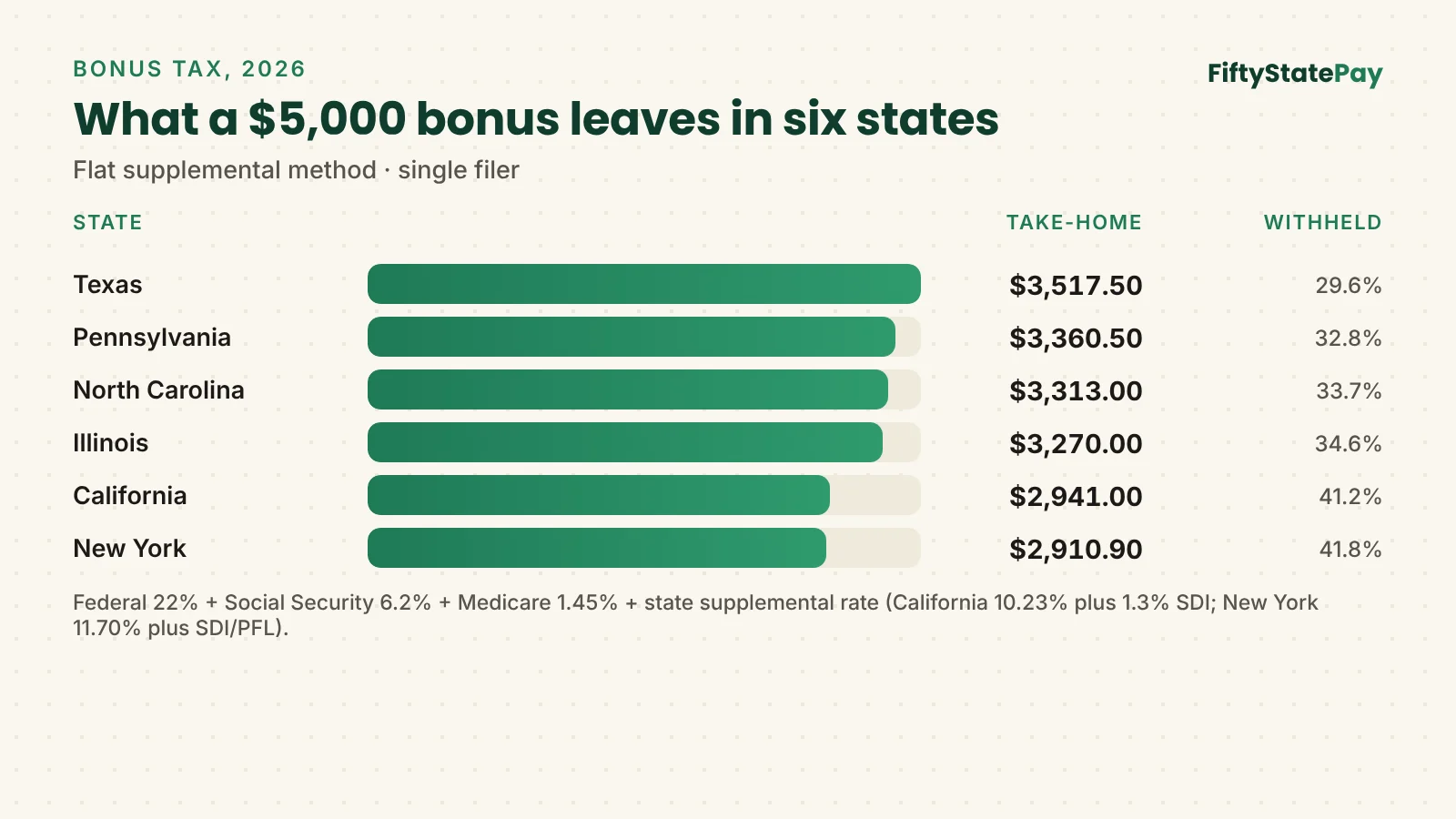
The bonus tax calculator covers all 50 states and DC. For states without a published flat rate, it uses the aggregate method.
Why Is My Bonus Taxed So High?
Quick answer
A bonus is not taxed at a higher rate than your salary. It only looks that way because withholding uses flat rates, and those can be above your real rate. For example, someone in the 12% bracket still has 22% withheld from a bonus. The extra comes back when they file their tax return.
On the other hand, people in the 32% bracket or higher may owe more at tax time, because 22% is less than their top rate. If that is you, consider asking for extra withholding on the bonus.
How to Keep More of Your Bonus
- Put part of the bonus into your 401(k), if your plan allows deferrals from bonuses. In 2026 you can defer up to $24,500 in total.
- Fund a health savings account (HSA) through payroll if you have a qualifying health plan.
- Check whether your employer can pay the bonus in January instead of December, if you expect a lower income next year.
- Run the IRS Tax Withholding Estimator after a large bonus to avoid a surprise bill or an oversized refund.
Sign-On, Year-End and Retention Bonuses
All of these are supplemental wages, so the same rules apply. A sign-on bonus, a holiday bonus, a referral bonus and a retention bonus are all taxed as income and usually withheld at 22% federal. Cash gifts and gift cards from an employer are taxable wages too.
Commissions, severance pay and payouts of unused vacation are also supplemental wages. So you can use the bonus tax calculator for them as well.
Related Pay Calculators
Pay raise calculator
Shows a new salary and what you keep.
Federal income tax calculator
Estimates 2026 tax, refund or amount owed.
Overtime calculator
Figures overtime pay before and after tax.
Salary to hourly calculator
Converts a salary to an hourly wage.
Need your full paycheck? Open the paycheck calculator for your state, or see all free pay tools.
Bonus Tax Calculator FAQ
What is the federal tax rate on bonuses in 2026?
Employers usually withhold 22% for federal income tax on bonuses. Supplemental wages above $1 million in a year are withheld at 37%.
How much of a $5,000 bonus will I keep?
In a no-tax state like Texas, about $3,517.50 after 22% federal tax and 7.65% FICA. In California it is about $2,941.00.
Are bonuses taxed more than regular pay?
No. They are taxed as regular income. Withholding often uses a flat 22%, which can be more or less than your actual rate.
Will I get bonus tax back?
Maybe. If your real tax rate is below the withholding rate, the extra is refunded when you file your return.
What is the aggregate method for bonuses?
Your employer adds the bonus to a regular paycheck and withholds as if the bigger check were your normal pay, then subtracts tax already figured on the regular part.
How are bonuses taxed in California?
California withholds 10.23% on bonuses, plus 1.3% SDI, on top of federal tax and FICA.
Can I put my bonus into my 401(k)?
Often yes, if your plan allows deferrals from bonuses. Those dollars skip federal income tax now but still pay Social Security and Medicare.
Estimates, not tax advice
This bonus tax calculator shows estimated withholding based on 2026 federal and state rules. Withholding is not your final tax. It is not tax, legal or financial advice.
Sources
- IRS Publication 15 (Circular E), Employer’s Tax GuideInternal Revenue Service Official
- IRS Publication 15-T (2026), Federal Income Tax Withholding MethodsInternal Revenue Service Official
- Contribution and Benefit Base (2026)Social Security Administration Official
- Tax Withholding EstimatorInternal Revenue Service Official
- California Withholding Schedules for 2026California Employment Development Department Official
See your bonus after tax
Now you know how bonuses are taxed and why withholding looks high. Enter your bonus and state in the bonus tax calculator above.