

Updated for 2026 paychecks · state, local and Philadelphia tax
Pennsylvania Paycheck Calculator 2026: State and Local Tax
Use this Pennsylvania paycheck calculator to see your 2026 take-home pay after federal tax, Pennsylvania’s flat 3.07% income tax and your local earned income tax. It also covers Philadelphia’s wage tax and other city rates, so you see what really reaches your account.
Pennsylvania’s state tax is simple. Local taxes are not, because more than 2,500 municipalities and school districts set their own rates. That is why the local line on your pay stub matters so much here.
- Flat 3.07% state rate
- Philadelphia wage tax from July 1, 2026
- Local EIT and LST explained
- Free, private, no sign-up
2026Federal + all 50 states + DC
Enter your pay and pick your city or local rate. Your 2026 Pennsylvania take-home pay updates as you type.
Example take-home pay
$1,865.62 every two weeks
On a $60,000 salary in Pennsylvania (single filer): $48,506 a year after federal income tax, Social Security, Medicare and state taxes.
Estimates for paychecks paid in 2026 using each agency’s published withholding method. Your employer’s payroll may differ by a few cents through rounding or plan details. This is not tax, legal or financial advice.
Last updated October 21, 2026 · Data: 2026 tax rules in force October 2026 (data 2026.10.2) · By Hamza Akram · How we calculate
How to Use the Pennsylvania Paycheck Calculator
Quick answer
Enter your salary or hourly pay and your pay schedule, then copy your federal W-4. Next, choose your local tax: Philadelphia, Pittsburgh, another listed city, or your own municipality’s earned income tax rate. The Pennsylvania paycheck calculator applies 3.07% state tax and shows your net pay per check and per year.
Enter your pay.
Salary, or hourly with overtime hours.
Choose your pay frequency.
Weekly, biweekly, semimonthly or monthly.
Copy your W-4.
Pennsylvania has no state allowance form, so only the federal W-4 matters for withholding.
Pick your local tax.
Philadelphia residents and commuters have their own rates. Elsewhere, enter the earned income tax rate for where you live.
Add deductions.
Remember that Pennsylvania taxes 401(k) contributions, even though they lower federal tax.
Pennsylvania Income Tax Rate 2026
Quick answer
Pennsylvania taxes wages at a flat 3.07%, the same rate for every income level. There is no standard deduction or allowance, so employers simply multiply your taxable wages by 3.07%. On a $60,000 salary that is $1,842 a year, or $70.85 per biweekly paycheck.
3.07%
Pennsylvania income tax
flat, every income
3.735%
Philadelphia wage tax
residents, from July 1, 2026
$52
Local Services Tax maximum
per year, where levied
Pennsylvania’s rule on retirement savings is unusual. Your own 401(k), 403(b) and 457 contributions are taxed for state purposes when you earn them. In return, the state generally does not tax that money when you withdraw it in retirement.
Pennsylvania Paycheck Example: $60,000 Salary
Quick answer
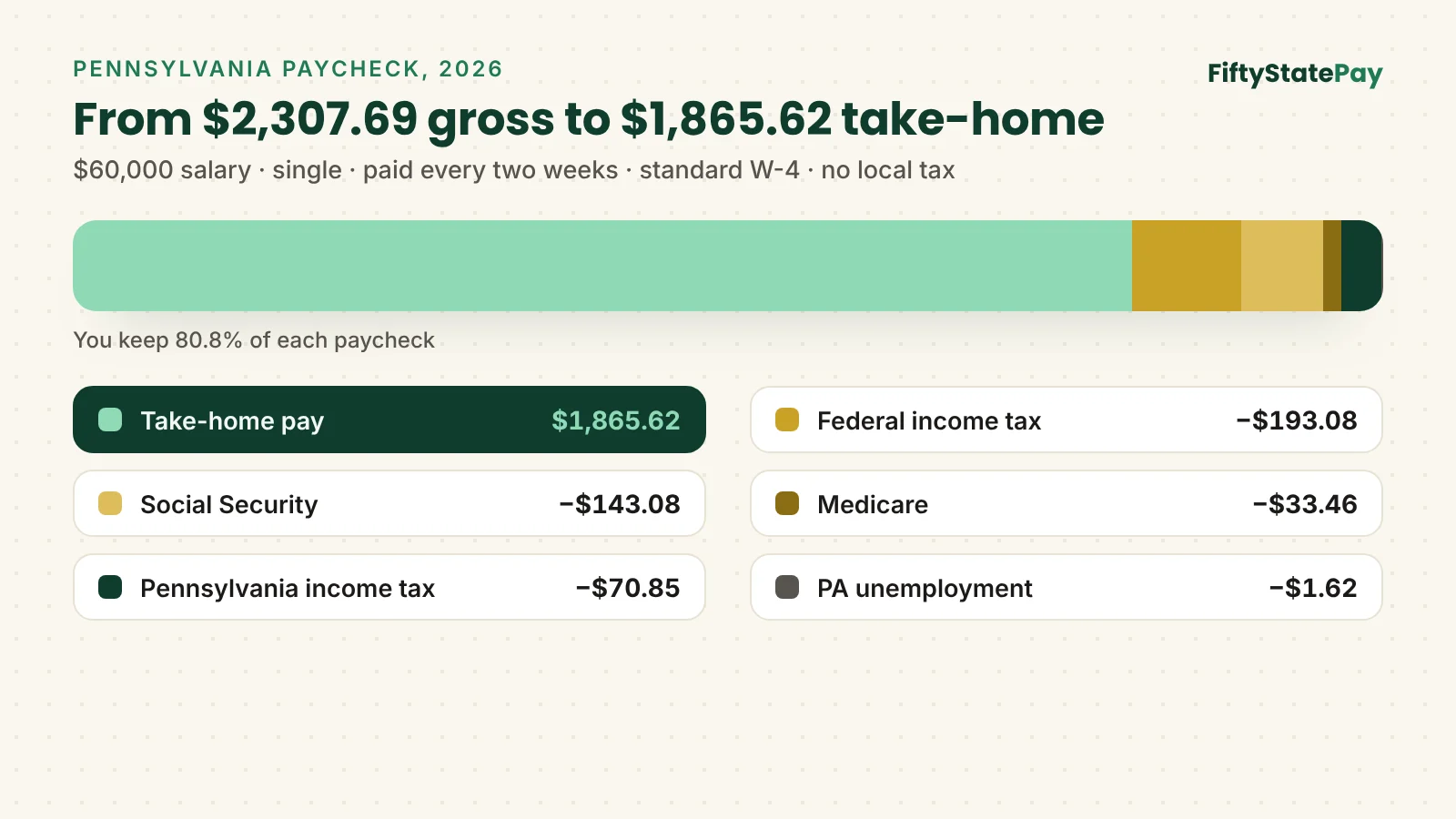
A single Pennsylvania worker earning $60,000, paid every two weeks with no local tax, takes home $1,865.62 per paycheck in 2026, or $48,506 a year. State tax is $70.85 per check and unemployment insurance is $1.62. Local earned income tax would come on top.
Biweekly pay stub: $60,000 salary in Pennsylvania (2026)
Earnings
- Gross pay$60,000 ÷ 26 paychecks
- $2,307.69
Taxes
- Federal income taxIRS percentage method, single, standard W-4
- −$193.08
- Social Security6.2%
- −$143.08
- Medicare1.45%
- −$33.46
- Pennsylvania income taxflat 3.07%
- −$70.85
- PA unemploymentemployee share 0.07%
- −$1.62
- Net pay
- $1,865.62
Worked examplePennsylvania paycheck math, step by step
Gross pay: $60,000 ÷ 26 = $2,307.69.
- Federal income tax: $193.08 (IRS percentage method, single).
- Social Security $143.08 and Medicare $33.46.
- Pennsylvania tax: 3.07% × $2,307.69 = $70.85.
- PA unemployment (employee share): 0.07% × $2,307.69 = $1.62.
Take-home pay before any local tax: $1,865.62.
Pennsylvania Local Income Tax: EIT and LST
Quick answer
Most Pennsylvania workers also pay a local earned income tax (EIT), often split between the municipality and the school district. Your employer withholds the higher of your home rate or your work location’s nonresident rate. Many places also charge a Local Services Tax of up to $52 a year.
| Where you live or work | Local rate | Local tax per paycheck | Take-home per paycheck |
|---|---|---|---|
| Philadelphia resident | 3.735% | $86.19 | $1,779.42 |
| Philadelphia nonresident (works in the city) | 3.425% | $79.04 | $1,786.58 |
| Pittsburgh resident (city + school) | 3% | $69.23 | $1,796.38 |
Note: Pennsylvania local taxes apply to gross wages, so 401(k) contributions do not lower them. Rates outside the cities listed vary; look yours up in the state’s Municipal Statistics database.
Philadelphia wage tax
Philadelphia charges 3.735% on residents and 3.425% on nonresidents who work in the city, effective July 1, 2026. On a $60,000 salary, the resident rate takes $86.19 every two weeks. So a Philadelphia resident keeps $1,779.42 per paycheck instead of $1,865.62.
Local Services Tax
The Local Services Tax (LST) is a flat yearly charge of up to $52, usually split across your paychecks. Where the tax is more than $10, people earning less than $12,000 a year can apply for an exemption.
Which local rate does your employer use?
Under Act 32, employers in Pennsylvania withhold local earned income tax based on two rates: the resident rate where you live and the nonresident rate where you work. They then withhold the higher of the two. So if you live in a low-tax township but work in a city with a higher nonresident rate, you pay the city’s rate. That is why the Pennsylvania paycheck calculator asks for your own local rate.
To find your rates, first look up your home municipality and school district. Then look up your work location. Both appear in the state’s Municipal Statistics database, and your employer also uses a tax code (PSD code) to report them.
Pennsylvania Take-Home Pay by Salary
Quick answer
Before local tax, a single Pennsylvania worker keeps about $40,785 of a $50,000 salary, $59,238 of $75,000 and $76,040 of $100,000 in 2026. A typical 1% to 2% local tax lowers these amounts by $500 to $2,000 a year.
| Salary | Federal income tax | Pennsylvania income tax | Social Security + Medicare | Take-home pay per year | Per paycheck |
|---|---|---|---|---|---|
| $30,000 | $1,420 | $921 | $2,295 | $25,343 | $974.73 |
| $40,000 | $2,620 | $1,228 | $3,060 | $33,064 | $1,271.69 |
| $50,000 | $3,820 | $1,535 | $3,825 | $40,785 | $1,568.65 |
| $60,000 | $5,020 | $1,842 | $4,590 | $48,506 | $1,865.62 |
| $75,000 | $7,670 | $2,302 | $5,738 | $59,238 | $2,278.37 |
| $100,000 | $13,170 | $3,070 | $7,650 | $76,040 | $2,924.62 |
| $150,000 | $24,734 | $4,605 | $11,475 | $109,081 | $4,195.42 |
| $200,000 | $36,734 | $6,140 | $14,339 | $142,647 | $5,486.42 |
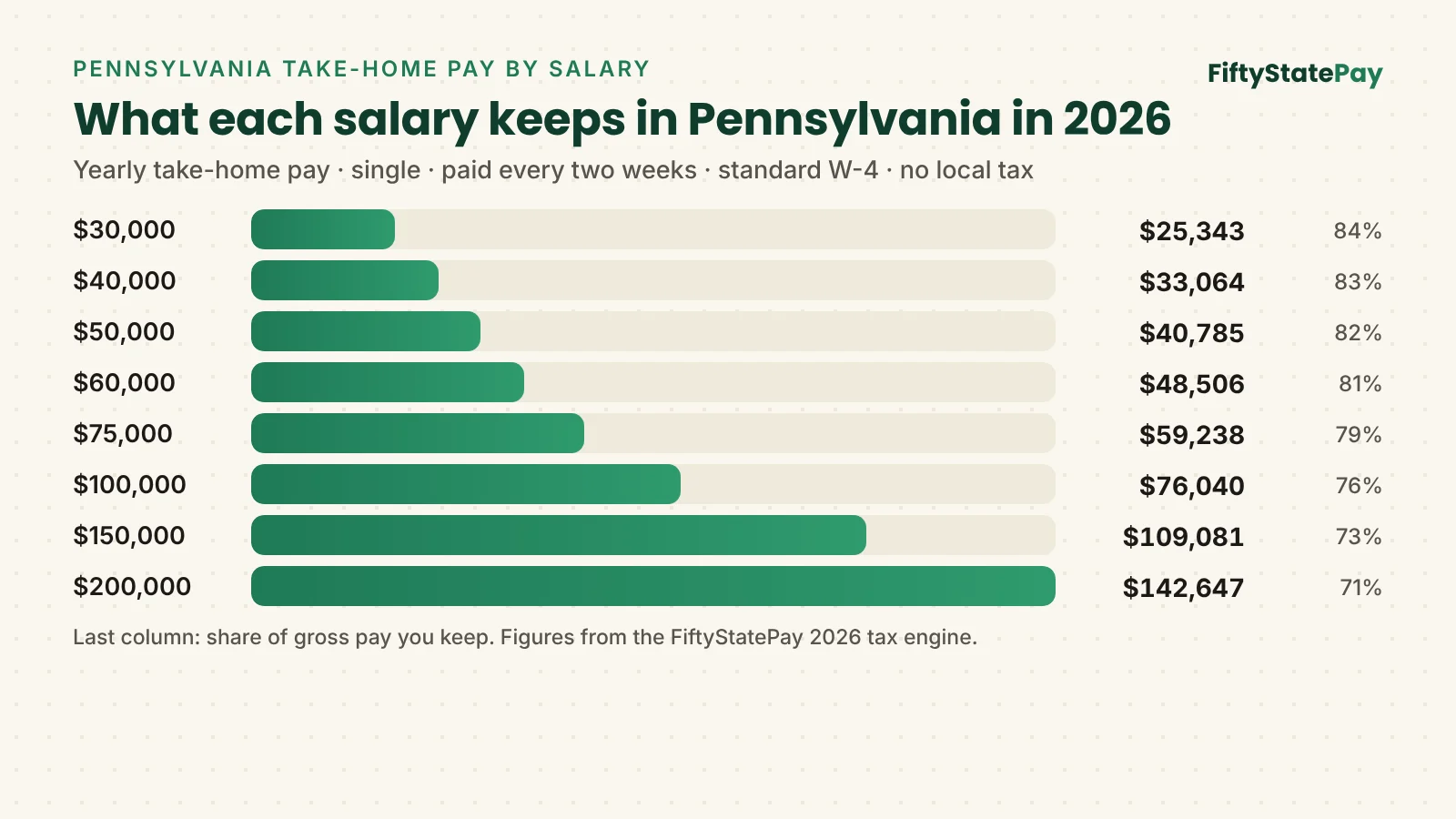
Try your own salary in the Pennsylvania paycheck calculator at the top of this page. Then add your local rate, because it often costs more than people expect.
Pennsylvania Hourly Paycheck Calculator
Quick answer
At $20 an hour for 40 hours, a single Pennsylvania worker takes home $659.60 a week before local tax. With five overtime hours, that becomes $775.42. Pennsylvania’s minimum wage is $7.25 an hour, the same as the federal rate.
| Item | 40 hours | 45 hours (5 overtime) |
|---|---|---|
| Gross pay | $800.00 | $950.00 |
| Federal income tax | −$54.08 | −$72.08 |
| Social Security and Medicare | −$61.20 | −$72.68 |
| Pennsylvania income tax | −$24.56 | −$29.17 |
| PA unemployment | −$0.56 | −$0.67 |
| Take-home pay | $659.60 | $775.42 |
Pennsylvania Bonus Tax
Quick answer
Pennsylvania taxes bonuses at the same flat 3.07% as regular pay. Employers usually add 22% federal withholding and FICA. So a $5,000 bonus leaves about $3,360.50 before local tax, which also applies to the bonus.
Federal Taxes on Every Pennsylvania Paycheck
Quick answer
Federal taxes are the biggest part of most Pennsylvania paychecks. Federal income tax follows your W-4. Social Security is 6.2% of wages up to $184,500 in 2026, and Medicare is 1.45% of all wages, plus 0.9% above $200,000.
| Tax rate | Single | Married filing jointly |
|---|---|---|
| 10% | $0 – $12,400 | $0 – $24,800 |
| 12% | $12,401 – $50,400 | $24,801 – $100,800 |
| 22% | $50,401 – $105,700 | $100,801 – $211,400 |
| 24% | $105,701 – $201,775 | $211,401 – $403,550 |
| 32% | $201,776 – $256,225 | $403,551 – $512,450 |
| 35% | $256,226 – $640,600 | $512,451 – $768,700 |
| 37% | Over $640,600 | Over $768,700 |
Source: IRS Revenue Procedure 2025-32. The 2026 standard deduction is $16,100 for single filers, $32,200 for married couples filing jointly and $24,150 for heads of household.
Pennsylvania vs. Other States
Quick answer
Before local tax, Pennsylvania ranks well among large states. On $60,000, a single worker keeps $48,506 in Pennsylvania, $47,424 in New York and $48,978 in Ohio. After a typical local tax, though, Pennsylvania lands close to Ohio.
How to Raise Your Pennsylvania Take-Home Pay
Quick answer
Pre-tax benefits shrink your taxable pay. On a $75,000 Pennsylvania salary, a 6% 401(k) puts $173.08 a paycheck into savings, yet take-home pay falls by only $135.00. The saving comes from federal tax only, because Pennsylvania still taxes 401(k) contributions.
- Pay health premiums and HSA contributions through a cafeteria plan. Pennsylvania excludes these from state tax.
- Make sure your employer has your correct home address, so your local tax rate is right.
- Apply for the Local Services Tax exemption if you earn under $12,000 a year.
- Check your W-4 once a year with the IRS Tax Withholding Estimator.
Why Your Pennsylvania Pay Stub May Differ
Our Pennsylvania paycheck calculator uses the state’s flat rate and the listed local rates. Your stub may still differ because of:
- A different local earned income tax rate for your home or work location.
- The Local Services Tax, if your work location charges it.
- Health, dental or vision premiums and other benefits taken before tax.
- Extra withholding you asked for on your federal W-4 or state form.
- Garnishments, union dues or other after-tax deductions.
- High year-to-date wages, after which Social Security stops for the year.
Read how we calculate or contact us with your details.
Pennsylvania Paycheck Calculator FAQ
What is the Pennsylvania income tax rate for 2026?
A flat 3.07% on taxable wages, with no allowances or standard deduction.
How much tax is taken out of a paycheck in Pennsylvania?
For a single $60,000 earner, about 19% before local tax: federal tax, FICA, 3.07% state tax and 0.07% unemployment insurance. Local tax usually adds 1% to 3.7%.
What is the Philadelphia wage tax rate?
3.735% for residents and 3.425% for nonresidents who work in Philadelphia, from July 1, 2026.
Are 401(k) contributions taxed in Pennsylvania?
Yes. Pennsylvania taxes your own 401(k), 403(b) and 457 contributions, although they still lower federal income tax.
What is $60,000 after taxes in Pennsylvania?
About $48,506 a year before local tax, or $1,865.62 every two weeks, for a single filer in 2026.
What is the Local Services Tax in Pennsylvania?
A flat local tax of up to $52 a year on people who work in a municipality that levies it, usually withheld in small amounts each paycheck.
Estimates, not tax advice
This Pennsylvania paycheck calculator gives estimates based on 2026 state, local and IRS rules. It is not tax, legal or financial advice. Local rates change, and your employer’s payroll settings decide your real withholding.
Sources
- IRS Publication 15-T (2026), Federal Income Tax Withholding MethodsInternal Revenue Service Official
- Contribution and Benefit Base (2026 Social Security wage base)Social Security Administration Official
- Tax Withholding EstimatorInternal Revenue Service Official
- Employer WithholdingPennsylvania Department of Revenue Official
- Municipal Statistics: EIT and LST ratesPennsylvania Department of Community and Economic Development Official
- Wage Tax (employers)City of Philadelphia Official
Check your Pennsylvania paycheck
You now know how state and local taxes shape a Pennsylvania paycheck. Choose your city above and see your exact 2026 take-home pay.