

Updated for 2026 paychecks · state and city tax
Michigan Paycheck Calculator 2026: State and City Income Tax
Use this Michigan paycheck calculator to see your 2026 take-home pay after federal tax, Michigan’s flat 4.25% income tax and city income tax where it applies. Enter your salary or hourly wage, your pay schedule and your MI-W4 exemptions, and see every deduction per paycheck and per year.
Michigan’s state tax is simple, but 24 cities add their own income tax. Detroit’s is the largest, so a Detroit resident’s paycheck looks quite different from one in Ann Arbor or Troy.
- Michigan withholding guide (2026)
- Detroit and 23 other city taxes
- Federal tax per IRS Publication 15-T
- Free, private, no sign-up
2026Federal + all 50 states + DC
Enter your pay and choose your city. Your 2026 Michigan take-home pay updates as you type.
Example take-home pay
$1,849.64 every two weeks
On a $60,000 salary in Michigan (single filer): $48,091 a year after federal income tax, Social Security, Medicare and state taxes.
Estimates for paychecks paid in 2026 using each agency’s published withholding method. Your employer’s payroll may differ by a few cents through rounding or plan details. This is not tax, legal or financial advice.
Last updated October 21, 2026 · Data: 2026 tax rules in force October 2026 (data 2026.10.2) · By Hamza Akram · How we calculate
How to Use the Michigan Paycheck Calculator
Quick answer
Enter your salary or hourly pay, your pay schedule and your federal W-4. Then add your MI-W4 exemptions and choose your city if it taxes income, such as Detroit or Grand Rapids. The Michigan paycheck calculator applies 4.25% state tax and city tax, and it shows your net pay per check and per year.
Enter your pay.
Salary, or hourly with overtime.
Choose your pay schedule.
Weekly, biweekly, semimonthly or monthly.
Copy your W-4.
Filing status, Step 2 and Step 3 credits.
Copy your MI-W4.
Count your personal and dependent exemptions. Each one removes $5,900 from yearly wages in 2026.
Pick your city.
Choose Detroit, Grand Rapids, another 1% city, or leave it blank if your city has no income tax.
Michigan Income Tax Rate 2026
Quick answer
Michigan taxes income at a flat 4.25% in 2026, the same as in 2025. For withholding, each personal and dependent exemption on your MI-W4 removes $5,900 from yearly wages, up from $5,800 in 2025. Bonuses and other supplemental pay are also withheld at 4.25%.
4.25%
Michigan income tax
flat, every income
$5,900
Personal exemption
2026, per exemption
2.4%
Detroit resident tax
highest city rate
The withholding formula is short. First, payroll annualizes your wages. Next, it subtracts $5,900 for each exemption. Then it multiplies the rest by 4.25% and divides by your number of paychecks. So the Michigan paycheck calculator matches payroll to the cent in most cases.
Michigan Paycheck Example: $60,000 Salary
Quick answer
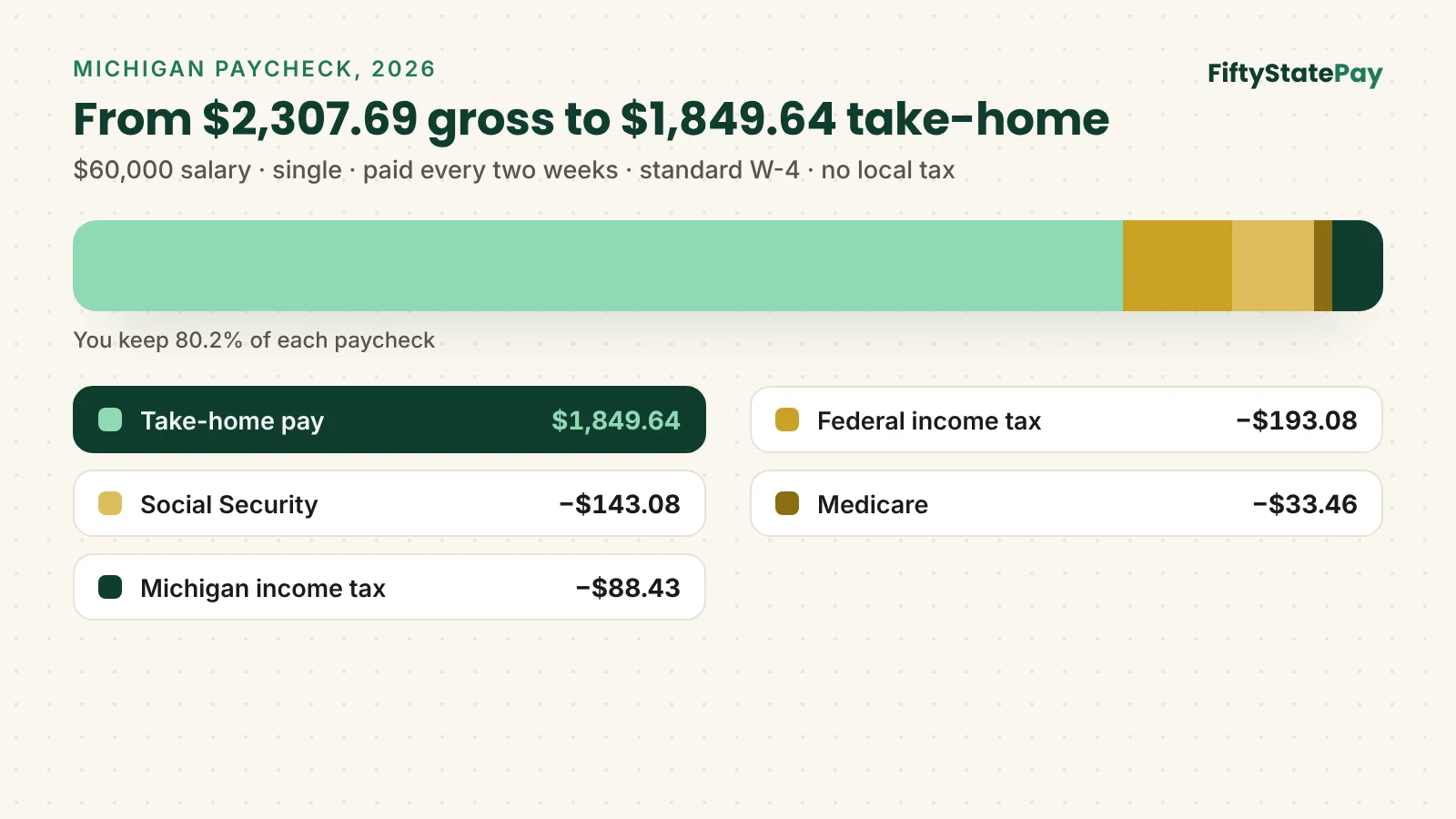
A single Michigan worker earning $60,000, paid every two weeks with one MI-W4 exemption and no city tax, takes home $1,849.64 per paycheck in 2026. That is $48,091 a year. Michigan tax is $88.43 per check. A Detroit resident would keep $1,794.81 instead.
Biweekly pay stub: $60,000 salary in Michigan (2026)
Earnings
- Gross pay$60,000 ÷ 26 paychecks
- $2,307.69
Taxes
- Federal income taxIRS percentage method, single, standard W-4
- −$193.08
- Social Security6.2%
- −$143.08
- Medicare1.45%
- −$33.46
- Michigan income tax4.25%, 1 exemption
- −$88.43
- Net pay
- $1,849.64
Worked exampleHow the Michigan paycheck calculator gets $1,849.64
Gross pay: $60,000 ÷ 26 = $2,307.69.
- Federal income tax: $193.08 (IRS percentage method, single).
- Social Security $143.08 and Medicare $33.46.
- Michigan tax: ($60,000 − $5,900) × 4.25% = $2,299.25 a year, or $88.43 per check.
Take-home pay before city tax: $1,849.64.
Michigan City Income Tax: Detroit and 23 More Cities
Quick answer
Twenty-four Michigan cities tax income. Most charge residents 1% and people who work there but live elsewhere 0.5%. Detroit charges 2.4% and 1.2%, while Grand Rapids and Saginaw charge 1.5% and 0.75%. Highland Park charges 2% and 1%. Each city exemption removes $600 from taxable wages.
| City | City rate | City tax per paycheck | Take-home per paycheck |
|---|---|---|---|
| Detroit resident | 2.4% | $54.83 | $1,794.81 |
| Detroit nonresident (works in Detroit) | 1.2% | $27.42 | $1,822.23 |
| Grand Rapids resident | 1.5% | $34.27 | $1,815.38 |
The 24 cities are Albion, Battle Creek, Benton Harbor, Big Rapids, Detroit, East Lansing, Flint, Grand Rapids, Grayling, Hamtramck, Highland Park, Hudson, Ionia, Jackson, Lansing, Lapeer, Muskegon, Muskegon Heights, Pontiac, Port Huron, Portland, Saginaw, Springfield and Walker. If your city is not on the list, you pay no city income tax.
Living in the suburbs and working in Detroit
If you live in a suburb with no city tax but work in Detroit, you pay the 1.2% nonresident rate on wages earned in the city. However, if you work from home part of the time, those days may not count as Detroit wages. So keep a record of where you work, because you may be able to claim a refund on your Detroit return.
Michigan Paycheck Rules for Workers From Nearby States
Quick answer
Michigan has reciprocal agreements with Illinois, Indiana, Kentucky, Minnesota, Ohio and Wisconsin. So if you live in one of those states and work in Michigan, you can claim an exemption on your MI-W4. Then your employer withholds no Michigan tax, and you pay your home state instead.
For example, an Ohio resident who commutes to Michigan can stop Michigan withholding this way. In that case, the employer usually withholds Ohio tax instead, if it is registered there. City taxes are different, though, because reciprocity does not cover them. So a Toledo resident working in Detroit still pays Detroit’s nonresident tax.
Michigan Take-Home Pay by Salary
Quick answer
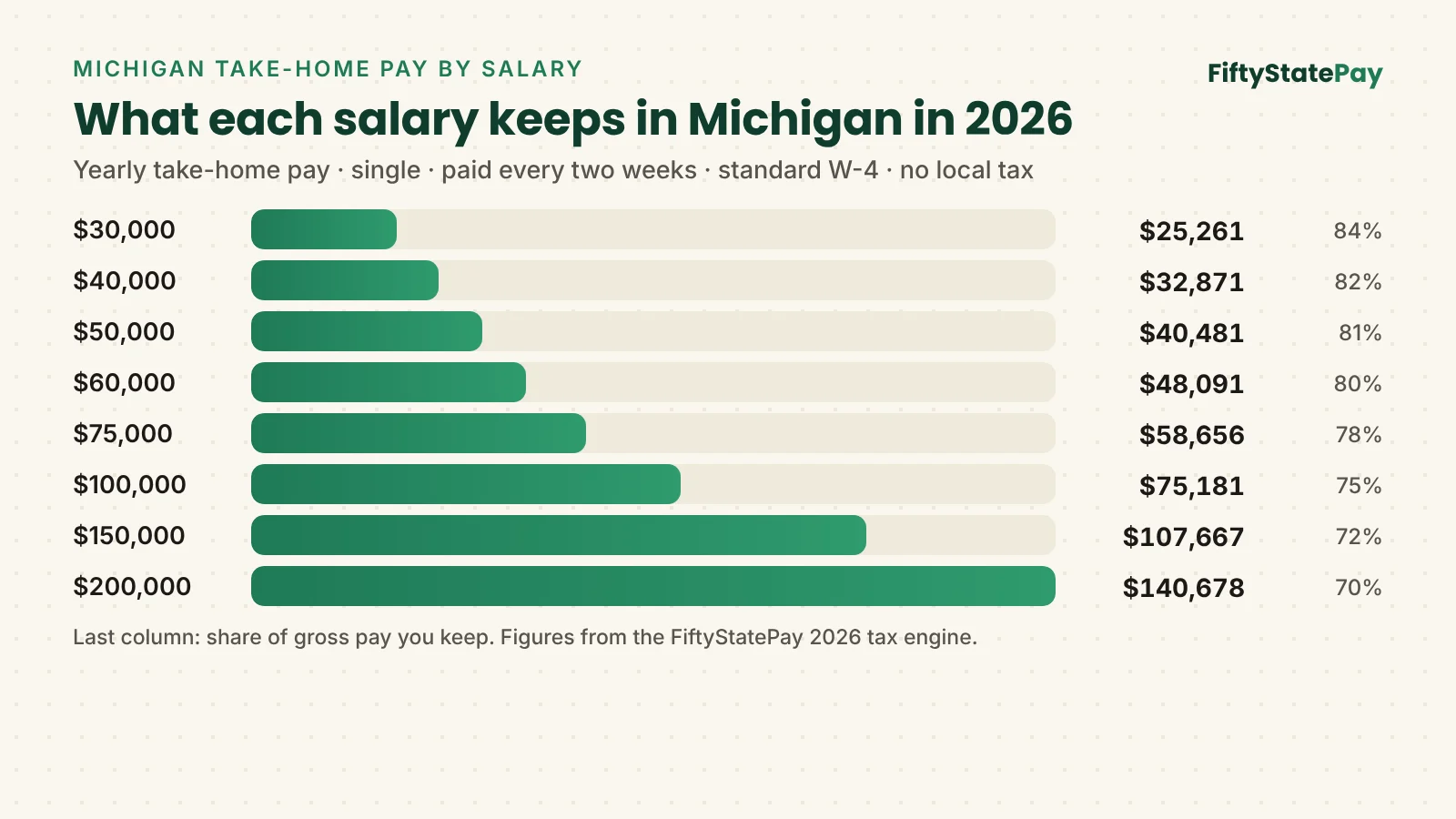
Before city tax, a single Michigan worker keeps about $40,481 of a $50,000 salary, $58,656 of $75,000 and $75,181 of $100,000 in 2026. A 1% city tax lowers those amounts by roughly $500 to $1,000 a year, and Detroit’s 2.4% rate by about $1,200 to $2,400.
| Salary | Federal income tax | Michigan income tax | Social Security + Medicare | Take-home pay per year | Per paycheck |
|---|---|---|---|---|---|
| $30,000 | $1,420 | $1,024 | $2,295 | $25,261 | $971.57 |
| $40,000 | $2,620 | $1,449 | $3,060 | $32,871 | $1,264.26 |
| $50,000 | $3,820 | $1,874 | $3,825 | $40,481 | $1,556.95 |
| $60,000 | $5,020 | $2,299 | $4,590 | $48,091 | $1,849.64 |
| $75,000 | $7,670 | $2,937 | $5,738 | $58,656 | $2,255.99 |
| $100,000 | $13,170 | $3,999 | $7,650 | $75,181 | $2,891.57 |
| $150,000 | $24,734 | $6,124 | $11,475 | $107,667 | $4,141.03 |
| $200,000 | $36,734 | $8,249 | $14,339 | $140,678 | $5,410.68 |
Michigan Hourly Paycheck Calculator
Quick answer
At $20 an hour for 40 hours, a single Michigan worker takes home $655.55 a week before city tax. With five overtime hours, take-home rises to $769.70. Michigan’s minimum wage is $13.73 an hour in 2026 and is scheduled to reach $15.00 in 2027.
| Item | 40 hours | 45 hours (5 overtime) |
|---|---|---|
| Gross pay | $800.00 | $950.00 |
| Federal income tax | −$54.08 | −$72.08 |
| Social Security and Medicare | −$61.20 | −$72.68 |
| Michigan income tax | −$29.18 | −$35.55 |
| Take-home pay | $655.55 | $769.70 |
Michigan Bonus Tax
Quick answer
Michigan withholds 4.25% on bonuses, the same as on regular pay. Add 22% federal withholding and FICA, and a $5,000 bonus leaves about $3,305.00 before city tax. If you live or work in a taxing city, the bonus is taxed there too.
Federal Taxes on Every Michigan Paycheck
Quick answer
Federal taxes make up most of the deductions on a Michigan paycheck. Federal income tax depends on your W-4 and the 2026 IRS tables. Social Security is 6.2% of wages up to $184,500 in 2026, and Medicare is 1.45% of all wages, plus 0.9% above $200,000.
| Tax rate | Single | Married filing jointly |
|---|---|---|
| 10% | $0 – $12,400 | $0 – $24,800 |
| 12% | $12,401 – $50,400 | $24,801 – $100,800 |
| 22% | $50,401 – $105,700 | $100,801 – $211,400 |
| 24% | $105,701 – $201,775 | $211,401 – $403,550 |
| 32% | $201,776 – $256,225 | $403,551 – $512,450 |
| 35% | $256,226 – $640,600 | $512,451 – $768,700 |
| 37% | Over $640,600 | Over $768,700 |
Source: IRS Revenue Procedure 2025-32. The 2026 standard deduction is $16,100 for single filers, $32,200 for married couples filing jointly and $24,150 for heads of household.
Michigan vs. Other States
Quick answer
Before city tax, a single Michigan worker earning $60,000 keeps $48,091 in 2026. That is close to Georgia ($48,144) and a bit below Ohio before its city tax ($48,978). After Detroit’s 2.4% city tax, though, Michigan take-home drops to about $46,665.
| Michigan | $2,299 | $48,091 | $75,181 |
|---|---|---|---|
| Ohio | $1,412 | $48,978 | $76,572 |
| Illinois | $2,825 | $47,565 | $74,375 |
| Pennsylvania | $1,842 | $48,506 | $76,040 |
| Georgia | $2,246 | $48,144 | $74,938 |
| North Carolina | $1,924 | $48,466 | $75,618 |
| Texas | None | $50,390 | $79,180 |
How to Raise Your Michigan Take-Home Pay
Quick answer
Pre-tax benefits shrink your taxable pay. On a $75,000 Michigan salary, a 6% 401(k) puts $173.08 a paycheck into savings, yet take-home pay falls by only $127.64. Michigan follows the federal rule for state tax, so the 401(k) lowers both federal and Michigan tax.
- File an updated MI-W4 with all your exemptions. Each one saves about $251 a year in state tax.
- Contribute to a 401(k) or 403(b), up to $24,500 in 2026.
- Use pre-tax health and HSA benefits.
- If you work in a taxing city but live elsewhere, make sure your employer uses the lower nonresident rate.
Why Your Michigan Pay Stub May Differ
Our Michigan paycheck calculator follows the Michigan withholding guide and the city rates above. Your real stub may still differ because of:
- A different number of MI-W4 or city exemptions.
- Living in Illinois, Indiana, Kentucky, Minnesota, Ohio or Wisconsin, which have reciprocal agreements with Michigan.
- Health, dental or vision premiums and other benefits taken before tax.
- Extra withholding you asked for on your federal W-4 or state form.
- Garnishments, union dues or other after-tax deductions.
- High year-to-date wages, after which Social Security stops for the year.
See how we calculate or contact us.
Michigan Paycheck Calculator FAQ
What is the Michigan income tax rate for 2026?
A flat 4.25% on taxable income. The personal exemption for withholding is $5,900.
How much tax is taken out of a paycheck in Michigan?
For a single $60,000 earner, about 20% of each paycheck before city tax: federal income tax, Social Security, Medicare and 4.25% Michigan tax.
What is the Detroit city income tax rate?
2.4% for residents and 1.2% for nonresidents who work in Detroit.
Which Michigan cities have an income tax?
Twenty-four, including Detroit, Grand Rapids, Lansing, Flint, Saginaw, Pontiac and Battle Creek. The full list is on this page.
What is $60,000 after taxes in Michigan?
About $48,091 a year before city tax, or $1,849.64 every two weeks, for a single filer in 2026.
What is the Michigan minimum wage in 2026?
$13.73 an hour, with an increase to $15.00 scheduled for 2027.
Estimates, not tax advice
This Michigan paycheck calculator gives estimates based on 2026 Michigan, city and IRS rules. It is not tax, legal or financial advice. Your employer’s payroll settings decide what is actually withheld.
Sources
- IRS Publication 15-T (2026), Federal Income Tax Withholding MethodsInternal Revenue Service Official
- Contribution and Benefit Base (2026 Social Security wage base)Social Security Administration Official
- Tax Withholding EstimatorInternal Revenue Service Official
- Calendar Year Tax Information (withholding rate and exemption)Michigan Department of Treasury Official
- City Income TaxMichigan Department of Treasury Official
- Estimators and CalculatorsMichigan Department of Treasury Official
Check your Michigan paycheck
Now you know how Michigan’s flat tax and city taxes shape your pay. Enter your pay and city in the Michigan paycheck calculator above.