

New for tax years 2025–2028 · federal income tax
No Tax on Overtime Calculator 2026: Estimate Your Deduction
Use this no tax on overtime calculator to estimate your new federal overtime deduction and the income tax it saves. Enter your filing status, your wages and either your overtime hours or the qualified overtime amount, and see your 2026 deduction and savings.
The no tax on overtime deduction lets eligible workers deduct the premium part of overtime required by federal law, up to $12,500 a year, or $25,000 for married couples filing jointly. It applies to tax years 2025 through 2028.
- Based on 26 U.S.C. § 225 and IRS guidance
- Cap and income phase-out built in
- Federal income tax savings in dollars
- Free, private, no sign-up
2026Pay tool
Estimates for paychecks paid in 2026 using each agency’s published withholding method. Your employer’s payroll may differ by a few cents through rounding or plan details. This is not tax, legal or financial advice.
Last updated October 21, 2026 · By Hamza Akram · How we calculate
What Is the No Tax on Overtime Deduction?
Quick answer
It is a federal income tax deduction created by the 2025 tax law for "qualified overtime compensation." You can deduct the extra pay above your regular rate for overtime that the Fair Labor Standards Act requires. The limit is $12,500, or $25,000 on a joint return, and it shrinks at higher incomes.
$12,500
Maximum deduction
single, head of household
$25,000
Maximum deduction
married filing jointly
2025–2028
Tax years covered
claimed when you file
The deduction is not a paycheck exemption. Your employer still withholds tax on overtime during the year, and Social Security and Medicare still apply. Instead, you claim the deduction on your federal return, which lowers your income tax and may raise your refund.
How to Use the No Tax on Overtime Calculator
Quick answer
Choose your filing status and enter your total wages for the year, including overtime. Then either enter your regular rate, overtime hours a week and weeks with overtime, or type the qualified overtime amount from your pay records. The no tax on overtime calculator shows your deduction and the federal tax it saves.
Pick your filing status.
Single, head of household, married filing jointly or married filing separately.
Enter total wages.
Include your overtime. This sets your tax bracket and any phase-out.
Add other income.
Optional. Interest, side income and similar amounts count toward the income limit.
Enter your overtime.
Use hours and your rate, or the qualified amount your employer reports.
Read your savings.
See the deduction, your tax with and without it, and the dollars saved.
How the Overtime Deduction Is Calculated
Quick answer
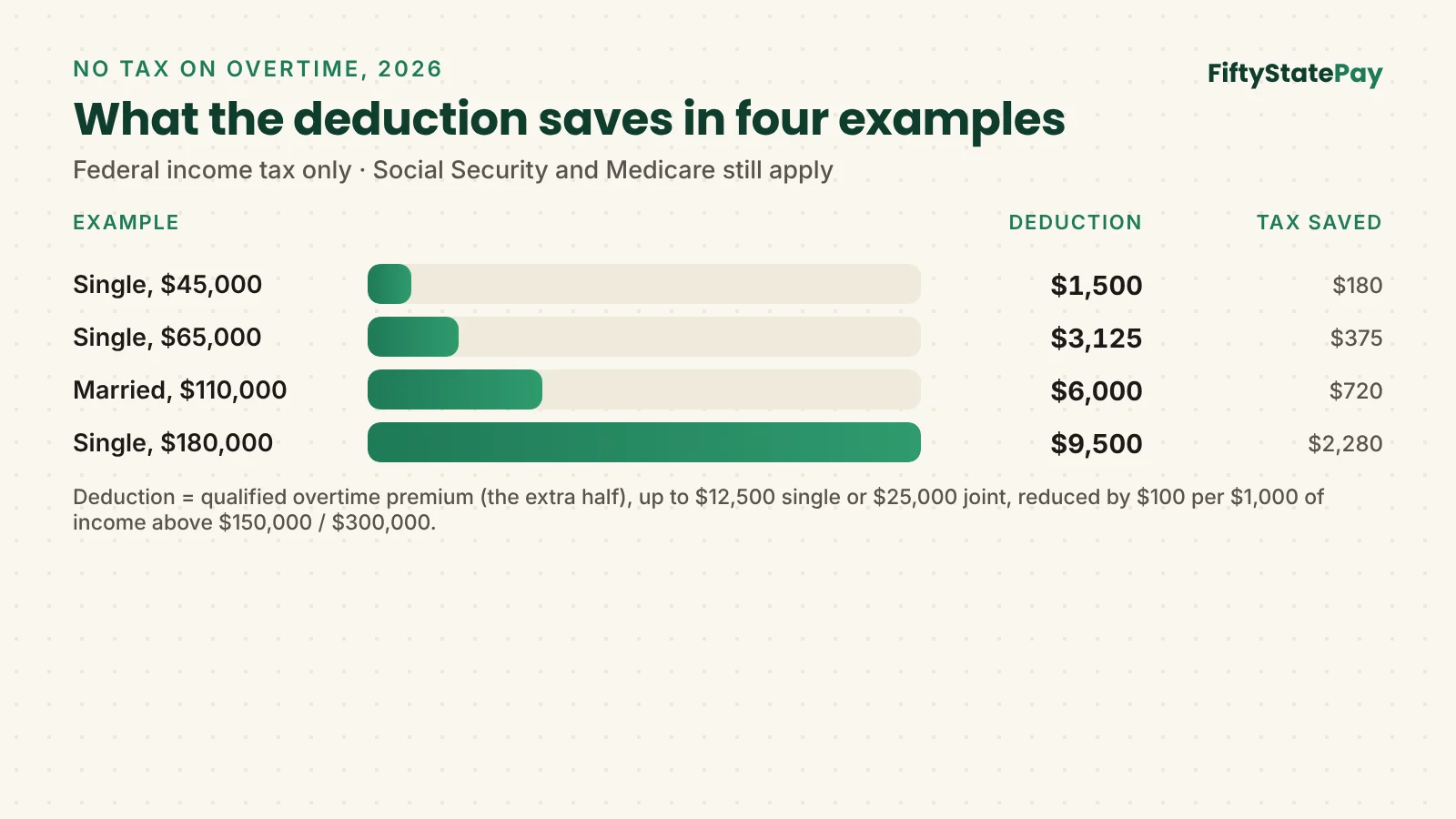
Only the premium counts. For time and a half, that is half your regular rate for each overtime hour. At $25 an hour, 5 overtime hours a week for 50 weeks gives a $3,125 premium. A single filer earning $65,000 who deducts it saves about $375 in federal income tax, because the deduction comes off income taxed at 12%.
Worked exampleSingle filer, $65,000 wages, $25 an hour
- Regular rate: $25.00 an hour. Overtime rate: $37.50.
- Premium per overtime hour: $37.50 − $25.00 = $12.50.
- Overtime: 5 hours a week × 50 weeks = 250 hours.
- Qualified overtime: 250 × $12.50 = $3,125.
- Tax saved at a 12% bracket: $3,125 × 12% = $375.
Note that the $25 straight-time part of each overtime hour is not deductible. Only the extra $12.50 is.
| Situation | Qualified overtime premium | Deduction | Federal tax saved |
|---|---|---|---|
| Single, $45,000 wages | $1,500 | $1,500 | $180 |
| Single, $65,000 wages | $3,125 | $3,125 | $375 |
| Head of household, $55,000 wages | $2,600 | $2,600 | $312 |
| Married filing jointly, $110,000 wages | $6,000 | $6,000 | $720 |
| Single, $180,000 wages | $12,500 | $9,500 | $2,280 |
| Married filing separately, $65,000 | $3,125 | $0 | $0 |
What Overtime Counts for the Tax Deduction?
Quick answer
Qualified overtime is the premium part of overtime that the federal Fair Labor Standards Act requires, usually the extra half for hours over 40 in a workweek. Overtime paid only because of a state law, a union contract or company policy does not count, and neither does your regular straight-time pay.
| Type of pay | Counts? | Why |
|---|---|---|
| The extra half for hours over 40 in a week (nonexempt worker) | Yes | Required by FLSA Section 7 |
| Straight-time pay for overtime hours | No | Only pay above the regular rate counts |
| Daily overtime required only by state law (such as over 8 hours in California) | No | Not required by the FLSA |
| Double time beyond the federal 1.5× | No | Only the FLSA-required half counts |
| Overtime for exempt salaried workers paid by choice | No | Not required by the FLSA |
| Holiday or weekend premiums under 40 hours | No | Not FLSA overtime |
Overtime Tax Deduction Income Limits
Quick answer
The deduction shrinks by $100 for every $1,000 of modified adjusted gross income above $150,000, or $300,000 on a joint return. For example, a single filer with $180,000 of income loses $3,000 of the $12,500 cap, so the most they can deduct is $9,500. That still saves them about $2,280 at a 24% rate.
Married couples must file jointly to claim it; married filing separately gets no deduction. You also need a valid Social Security number. You can take the deduction whether you itemize or use the standard deduction.
Will No Tax on Overtime Change My Paycheck?
Quick answer
Not automatically. Employers still withhold federal income tax, Social Security and Medicare on all overtime. If you expect the deduction, you can lower your withholding by entering the expected amount in Step 4(b) of a new Form W-4. Otherwise, the savings arrive as a bigger refund or a smaller balance due.
The law also requires employers to report qualified overtime separately to employees and the IRS. For 2025, the IRS did not require separate reporting, so workers could figure the amount from pay stubs using the Schedule 1-A instructions. Keep your pay stubs either way.
State income tax may still apply
This is a federal deduction. Each state decides whether to follow it, so overtime may still be taxed on your state return. Check your state tax agency before you count on state savings.
Related Pay Calculators
Overtime calculator
Figures overtime pay before and after tax.
Time and a half calculator
Gives your 1.5× and 2× rates.
Federal income tax calculator
Estimates 2026 tax, refund or amount owed.
Bonus tax calculator
Splits a bonus into tax and take-home.
Need your full paycheck? Open the paycheck calculator for your state, or see all free pay tools.
No Tax on Overtime Calculator FAQ
Is overtime tax-free now?
Not entirely. From 2025 through 2028, you can deduct the premium part of FLSA-required overtime from federal income, up to $12,500 or $25,000 jointly. Social Security, Medicare and usually state tax still apply.
How much is the no tax on overtime deduction?
Up to $12,500 a year for single and head of household filers, and up to $25,000 for married couples filing jointly, before any phase-out.
Who qualifies for the overtime deduction?
Workers who receive overtime required by the Fair Labor Standards Act, have a valid Social Security number and do not file as married filing separately.
Does the whole overtime check count?
No. Only the pay above your regular rate counts. For time and a half, that is the extra half.
When does the income phase-out start?
Above $150,000 of modified adjusted gross income, or $300,000 for joint filers. The cap drops by $100 for each $1,000 over.
Do I need to itemize to claim it?
No. You can claim it with the standard deduction or with itemized deductions.
How long does the deduction last?
It applies to tax years 2025, 2026, 2027 and 2028 unless Congress extends it.
Estimates, not tax advice
This no tax on overtime calculator gives estimates based on 26 U.S.C. § 225 and IRS guidance as of October 2026. It is not tax, legal or financial advice. For your own return, check IRS instructions or ask a CPA or enrolled agent.
Sources
- What to know about the No Tax on Overtime deductionInternal Revenue Service Official
- 26 U.S.C. § 225, Qualified overtime compensationCornell Legal Information Institute
- The "No Tax on Overtime" Deduction (IF13263)Congressional Research Service
- Overtime PayU.S. Department of Labor, Wage and Hour Division Official
- About Form W-4, Employee’s Withholding CertificateInternal Revenue Service Official
Estimate your overtime deduction
Now you know who qualifies and how the deduction works. Enter your wages and overtime in the no tax on overtime calculator above to see your 2026 savings.