

Free pay tool · updated for 2026
Salary to Hourly Calculator: Convert Your Salary to an Hourly Wage
Use this salary to hourly calculator to see what your yearly or monthly salary is worth per hour. Enter your salary, your weekly hours and your paid weeks, and you get your hourly rate, plus your daily, weekly, biweekly and monthly pay.
Your hourly rate is your salary divided by the hours you work in a year. For a full-time job that is 2,080 hours (40 hours × 52 weeks). The calculator also shows your take-home pay per hour after 2026 taxes in your state.
- Works for annual and monthly salaries
- Take-home per hour in all 50 states
- 2026 federal and state tax rules
- Free, private, no sign-up
2026Pay tool
Estimates for paychecks paid in 2026 using each agency’s published withholding method. Your employer’s payroll may differ by a few cents through rounding or plan details. This is not tax, legal or financial advice.
Last updated October 21, 2026 · By Hamza Akram · How we calculate
How to Use the Salary to Hourly Calculator
Quick answer
Enter your annual salary, the hours you work each week and the weeks you are paid each year. The salary to hourly calculator divides your salary by your yearly hours and shows your hourly rate at once. Then pick your state and filing status to see your take-home pay per hour after taxes.
Enter your salary.
Type your yearly salary. For a monthly salary, multiply it by 12 first.
Set your weekly hours.
Use 40 for a standard full-time job, or your real average, such as 37.5 or 45.
Set your paid weeks.
Keep 52 if your vacation and holidays are paid. Use fewer weeks only for unpaid time off.
Choose your state and status.
These set the taxes used for your take-home pay per hour.
Read your results.
You will see your hourly rate before tax, your pay per day, week, paycheck and month, and your take-home per hour.
How to Convert Salary to Hourly
Quick answer
To convert a salary to an hourly wage, divide your annual salary by the hours you work in a year. A full-time year is 40 hours × 52 weeks = 2,080 hours. For example, $50,000 ÷ 2,080 = $24.04 an hour, and $75,000 ÷ 2,080 = $36.06 an hour, before taxes.
Worked exampleSalary to hourly: $60,000 a year
Say you earn $60,000 a year and work 40 hours a week.
- Hours a year: 40 × 52 = 2,080
- Hourly rate: $60,000 ÷ 2,080 = $28.85
- Daily pay (8 hours): $28.85 × 8 = $230.77
- Weekly pay: $60,000 ÷ 52 = $1,153.85
A quick way to check it in your head: halve the salary and drop three zeros. So $60,000 becomes about $30 an hour. That shortcut uses 2,000 hours, so it runs a little high.
The formula works the same for any salary. However, the result changes if you work more or fewer hours, so always use your real schedule.
Salary to Hourly Conversion Table
Quick answer
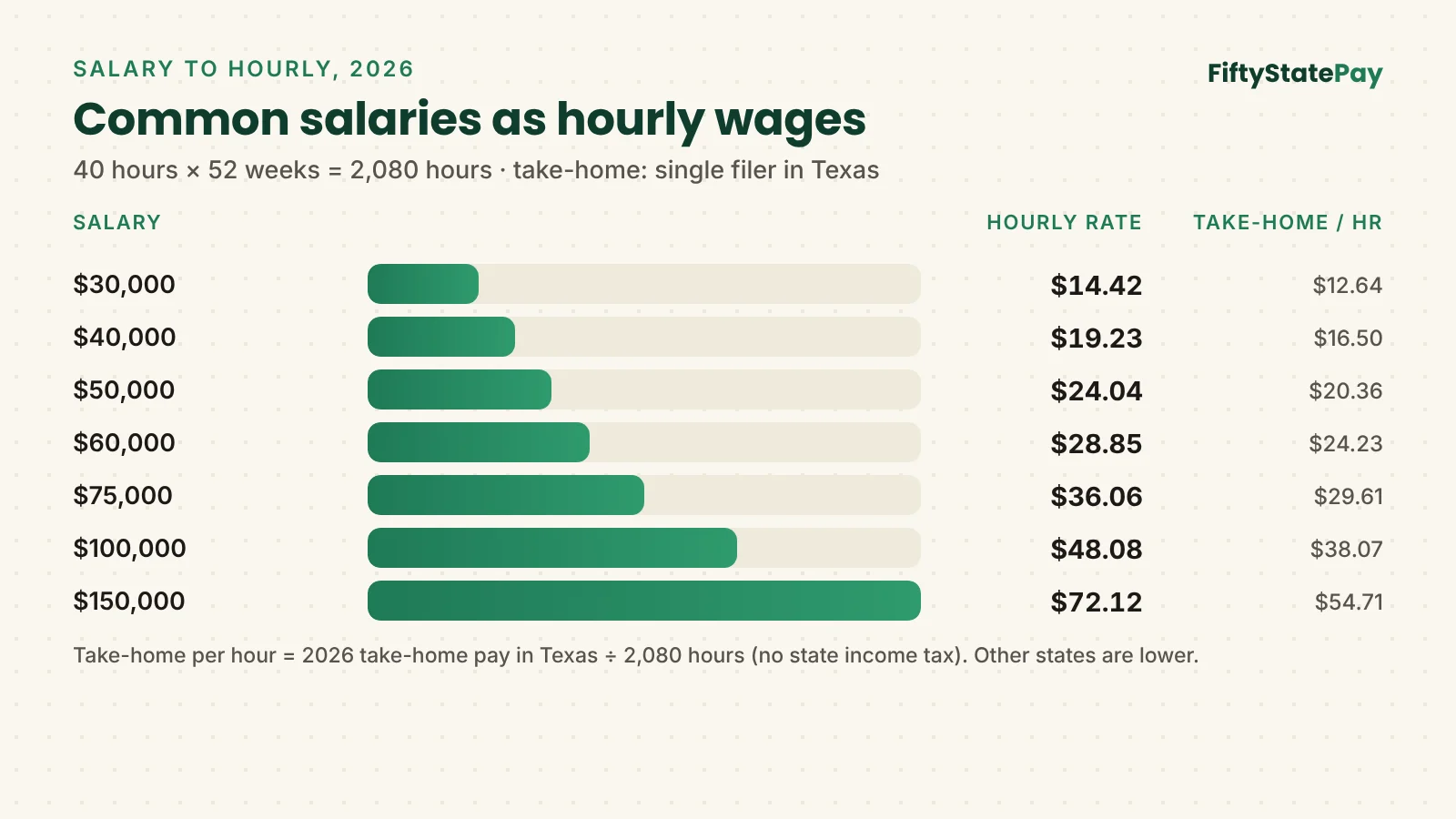
This salary to hourly conversion table shows common salaries at 2,080 hours a year. A $40,000 salary is $19.23 an hour, $60,000 is $28.85, $80,000 is $38.46 and $100,000 is $48.08. Weekly, biweekly and monthly pay are included, so you can compare a salary with any pay stub.
| Annual salary | Hourly | Weekly | Every two weeks | Monthly |
|---|---|---|---|---|
| $30,000 | $14.42 | $576.92 | $1,153.85 | $2,500.00 |
| $35,000 | $16.83 | $673.08 | $1,346.15 | $2,916.67 |
| $40,000 | $19.23 | $769.23 | $1,538.46 | $3,333.33 |
| $45,000 | $21.63 | $865.38 | $1,730.77 | $3,750.00 |
| $50,000 | $24.04 | $961.54 | $1,923.08 | $4,166.67 |
| $55,000 | $26.44 | $1,057.69 | $2,115.38 | $4,583.33 |
| $60,000 | $28.85 | $1,153.85 | $2,307.69 | $5,000.00 |
| $65,000 | $31.25 | $1,250.00 | $2,500.00 | $5,416.67 |
| $70,000 | $33.65 | $1,346.15 | $2,692.31 | $5,833.33 |
| $75,000 | $36.06 | $1,442.31 | $2,884.62 | $6,250.00 |
| $80,000 | $38.46 | $1,538.46 | $3,076.92 | $6,666.67 |
| $90,000 | $43.27 | $1,730.77 | $3,461.54 | $7,500.00 |
| $100,000 | $48.08 | $1,923.08 | $3,846.15 | $8,333.33 |
| $120,000 | $57.69 | $2,307.69 | $4,615.38 | $10,000.00 |
| $150,000 | $72.12 | $2,884.62 | $5,769.23 | $12,500.00 |
Monthly, Biweekly and Weekly Salary to Hourly
Quick answer
First turn your pay into a yearly amount, then divide by 2,080. Multiply a monthly salary by 12, a twice-a-month paycheck by 24, an every-two-weeks paycheck by 26 and a weekly paycheck by 52. So a $5,000 monthly salary is $60,000 a year, or $28.85 an hour.
| You are paid | Multiply your gross pay by | Then divide by | Example |
|---|---|---|---|
| Monthly | 12 | 2,080 | $4,000 a month = $23.08/hr |
| Twice a month (semimonthly) | 24 | 2,080 | $2,500 per check = $28.85/hr |
| Every two weeks (biweekly) | 26 | 2,080 | $2,000 per check = $25.00/hr |
| Weekly | 52 | 2,080 | $1,000 a week = $25.00/hr |
Use your gross pay, the amount before taxes and deductions. Otherwise, you are measuring your take-home pay per hour, which the salary to hourly calculator already shows separately.
How Your Hours Change Your Hourly Rate
Quick answer
The more hours you work for the same salary, the lower your real hourly rate. A $50,000 salary is $25.64 an hour at 37.5 hours a week but only $21.37 at 45 hours. So salaried workers who often stay late should use their true weekly hours in the calculator.
| Hours a week | Hours a year | Hourly rate |
|---|---|---|
| 35 | 1,820 | $27.47 |
| 37.5 | 1,950 | $25.64 |
| 40 | 2,080 | $24.04 |
| 45 | 2,340 | $21.37 |
| 50 | 2,600 | $19.23 |
Unpaid time off works the other way. For instance, if you take two unpaid weeks, you are paid for 50 weeks, or 2,000 hours. Then $50,000 is worth $25.00 an hour.
Salary to Hourly After Taxes
Quick answer
After taxes, your hourly pay is lower and depends on your state. A single person earning $60,000 keeps about $24.23 an hour in Texas, which has no income tax, and about $22.98 in California. The salary to hourly calculator shows this take-home rate for every state.
| Salary | Hourly before tax | Take-home per hour, Texas | Take-home per hour, California |
|---|---|---|---|
| $30,000 | $14.42 | $12.64 | $12.33 |
| $40,000 | $19.23 | $16.50 | $15.94 |
| $50,000 | $24.04 | $20.36 | $19.50 |
| $60,000 | $28.85 | $24.23 | $22.98 |
| $75,000 | $36.06 | $29.61 | $27.68 |
| $100,000 | $48.08 | $38.07 | $34.77 |
| $150,000 | $72.12 | $54.71 | $48.64 |
Take-home per hour subtracts federal income tax, Social Security and Medicare, plus state tax and SDI in California. For your own state, use the paycheck calculator for your state.
Salaried vs. Hourly: Overtime Rules
Quick answer
Being paid a salary does not always mean you lose overtime. Under federal law, salaried workers earning less than $684 a week ($35,568 a year) generally must get overtime. Above that, only workers whose duties meet an executive, administrative or professional test are exempt. Everyone else earns 1.5× pay after 40 hours.
That matters when you convert a salary to an hourly rate. If you are nonexempt and work 45 hours, you should be paid overtime for 5 of them. In contrast, an exempt employee’s salary covers all hours worked.
Some states set higher salary thresholds for exemption, so check your state labor department. Our overtime calculator shows what extra hours are worth.
How to Compare a Salary Offer With an Hourly Job
An hourly rate is a good starting point, but it is not the whole offer. Before you choose, compare these items side by side:
- Hours: Use the real weekly hours for each job, not the posted ones.
- Overtime: Hourly and nonexempt jobs pay 1.5× after 40 hours; exempt salaried jobs do not.
- Paid time off: Paid vacation and holidays raise the value of a salary.
- Benefits: Health insurance, a 401(k) match and bonuses can be worth thousands a year.
- Taxes: Take-home pay depends on your state, so compare after-tax pay too.
Related Pay Calculators
Hourly to salary calculator
Turns a wage into a yearly salary.
Pay raise calculator
Shows a new salary and what you keep.
Overtime calculator
Figures overtime pay before and after tax.
PTO accrual calculator
Counts paid time off earned each paycheck.
Need your full paycheck? Open the paycheck calculator for your state, or see all free pay tools.
Salary to Hourly Calculator FAQ
How do I convert my salary to an hourly rate?
Divide your annual salary by the hours you work in a year. For a 40-hour week, divide by 2,080. For example, $50,000 ÷ 2,080 = $24.04 an hour.
How much is $60,000 a year per hour?
About $28.85 an hour at 40 hours a week. After 2026 taxes, a single filer keeps about $24.23 an hour in Texas.
How much is $100,000 a year per hour?
About $48.08 an hour for a 40-hour week, before taxes.
Why is a full-time year 2,080 hours?
Because 40 hours a week × 52 weeks = 2,080 hours. Paid holidays and vacation are counted, since a salary pays for them.
How do I convert a monthly salary to hourly?
Multiply the monthly salary by 12, then divide by 2,080. A $4,000 monthly salary is $48,000 a year, or $23.08 an hour.
Do salaried employees get overtime?
Some do. Under federal law, salaried workers paid under $684 a week, or whose duties do not meet an exemption test, must get 1.5× pay after 40 hours.
Is the salary to hourly calculator free?
Yes. It is free, needs no sign-up and runs in your browser, so nothing you type is stored on our servers.
Estimates, not financial advice
This salary to hourly calculator gives estimates based on 2026 tax rules and the hours you enter. It is not tax, legal or financial advice. Your employer’s payroll and benefits decide your actual pay.
Sources
- Overtime PayU.S. Department of Labor, Wage and Hour Division Official
- Fact Sheet 17A: Exemption for Executive, Administrative, Professional, Computer and Outside Sales EmployeesU.S. Department of Labor Official
- IRS Publication 15-T (2026), Federal Income Tax Withholding MethodsInternal Revenue Service Official
- Contribution and Benefit Base (2026)Social Security Administration Official
Convert your salary now
Now you know how to turn a salary into an hourly wage. Scroll up, enter your salary and hours in the salary to hourly calculator, and see your before-tax and take-home rate.