

Updated for 2026 brackets and the new deductions
Federal Income Tax Calculator 2026: Estimate Your Tax and Refund
Use this federal income tax calculator to estimate your 2026 federal income tax, effective rate and refund or amount owed. Enter your filing status, wages, other income, dependents and any tips or overtime, and see each step of the math.
Federal income tax is the tax the IRS charges on your taxable income: your income minus deductions. The 2026 rates run from 10% to 37%, and the calculator applies them with the new standard deduction and credits.
- 2026 brackets and standard deductions
- Child tax credit, tips, overtime and senior deductions
- Refund or amount owed
- Free, private, no sign-up
2026Pay tool
Estimates for paychecks paid in 2026 using each agency’s published withholding method. Your employer’s payroll may differ by a few cents through rounding or plan details. This is not tax, legal or financial advice.
Last updated October 21, 2026 · By Hamza Akram · How we calculate
How to Use the Federal Income Tax Calculator
Quick answer
Choose your filing status and enter your wages from Form W-2, box 1. Add any other income, adjustments and itemized deductions. Next, enter children, other dependents, people 65 or older, tips and overtime. Finally, add the federal tax withheld so far to see an estimated refund or balance due.
Pick a filing status.
Single, married filing jointly, head of household or married filing separately.
Enter wages.
Use W-2 box 1, which is already lowered by pre-tax 401(k) and health deductions.
Include other income and adjustments.
For example, interest or side income, and IRA or HSA contributions made outside payroll.
Count your family.
Children under 17, other dependents and anyone 65 or older.
Add tips, overtime and withholding.
Enter qualified tips and overtime premium, plus the federal tax withheld from your pay stubs.
2026 Federal Income Tax Brackets
Quick answer
For 2026, the seven federal tax rates are 10%, 12%, 22%, 24%, 32%, 35% and 37%. For a single filer, the 10% rate covers taxable income up to $12,400, 12% goes to $50,400, and 22% goes to $105,700. Married couples filing jointly have brackets twice as wide up to the 35% rate.
| Tax rate | Single | Married filing jointly | Head of household |
|---|---|---|---|
| 10% | $0 – $12,400 | $0 – $24,800 | $0 – $17,700 |
| 12% | $12,401 – $50,400 | $24,801 – $100,800 | $17,701 – $67,450 |
| 22% | $50,401 – $105,700 | $100,801 – $211,400 | $67,451 – $105,700 |
| 24% | $105,701 – $201,775 | $211,401 – $403,550 | $105,701 – $201,750 |
| 32% | $201,776 – $256,225 | $403,551 – $512,450 | $201,751 – $256,200 |
| 35% | $256,226 – $640,600 | $512,451 – $768,700 | $256,201 – $640,600 |
| 37% | Over $640,600 | Over $768,700 | Over $640,600 |
Source: IRS (IR-2025-103). Married filing separately uses the single brackets up to 35%, which ends at $384,350.
Federal Income Tax Deductions for 2026
Quick answer
The 2026 standard deduction is $16,100 for single filers, $32,200 for married couples filing jointly and $24,150 for heads of household. People 65 or older add $2,050 if single or $1,650 each if married. For 2025 to 2028, there are also new deductions for tips, overtime and seniors.
| Deduction | Maximum | Phase-out starts (MAGI) | Who can claim it |
|---|---|---|---|
| Qualified tips | $25,000 | $150,000 ($300,000 joint) | Workers in jobs that customarily get tips |
| Qualified overtime premium | $12,500 ($25,000 joint) | $150,000 ($300,000 joint) | Workers paid FLSA-required overtime |
| Senior deduction | $6,000 per person 65+ | $75,000 ($150,000 joint) | People 65 or older |
Also, you can claim these whether or not you itemize. However, married couples must file jointly and you need a valid Social Security number. Learn more with our no tax on overtime calculator.
How Federal Income Tax Is Calculated
Quick answer
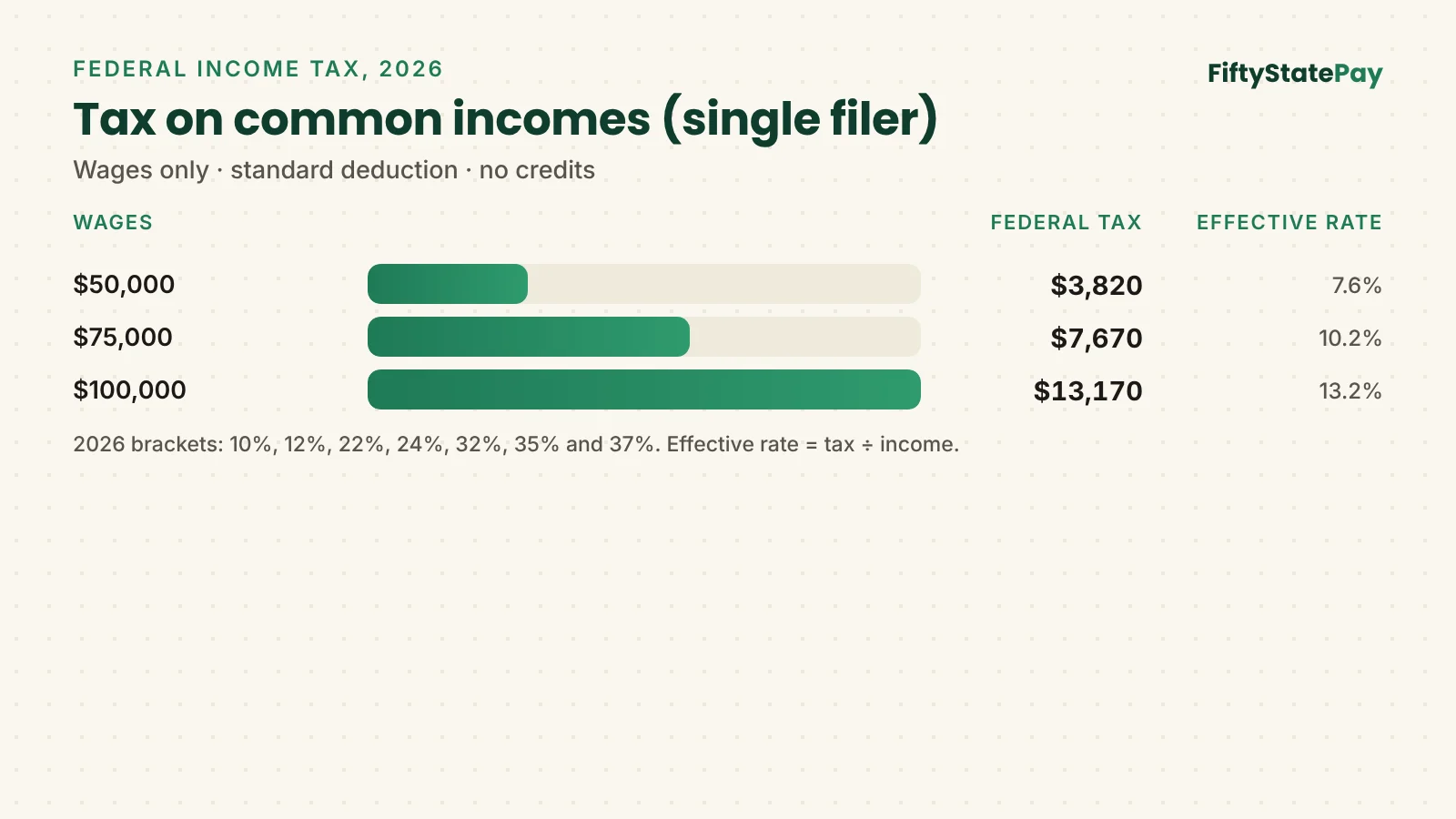
First, add up your income and subtract adjustments to get adjusted gross income. Next, subtract the standard or itemized deduction and any new deductions to get taxable income. Then apply the brackets and subtract credits. For example, $75,000 of wages for a single filer means $7,670 of tax, an effective rate of 10.2%.
Worked exampleSingle filer, $75,000 of wages in 2026
- Wages: $75,000. Adjustments: $0. So AGI = $75,000.
- Standard deduction: −$16,100. So taxable income = $58,900.
- 10% on the first $12,400 = $1,240.
- 12% on $12,400 to $50,400 ($38,000) = $4,560.
- 22% on $50,400 to $58,900 ($8,500) = $1,870.
- Total tax: $1,240 + $4,560 + $1,870 = $7,670.
So even though this filer is in the 22% bracket, only $8,500 is taxed at 22%. As a result, their effective rate is $7,670 ÷ $75,000 = 10.2%.
Marginal vs. Effective Tax Rate
Quick answer
Your marginal rate is the rate on your last dollar of taxable income, the bracket you are "in." Your effective rate is your total tax divided by your income. Because lower brackets apply first, your effective rate is always lower than your marginal rate. A $75,000 single filer has a 22% marginal and 10.2% effective rate.
| Situation | Taxable income | Federal income tax | Effective rate | Marginal rate |
|---|---|---|---|---|
| Single, $50,000 | $33,900 | $3,820 | 7.6% | 12% |
| Single, $75,000 | $58,900 | $7,670 | 10.2% | 22% |
| Single, $100,000 | $83,900 | $13,170 | 13.2% | 22% |
| Head of household, $55,000, 1 child | $30,850 | $1,148 | 2.1% | 12% |
| Married jointly, $120,000, 2 children | $87,800 | $5,640 | 4.7% | 12% |
| Married jointly, both 65+, $70,000 | $22,500 | $2,250 | 3.2% | 10% |
Note: The child examples subtract the $2,200 child tax credit per child. The senior example includes the extra standard deduction and the $6,000 senior deduction for each spouse. Effective rate here = tax ÷ total income.
Tax Credits That Lower Your Federal Income Tax
Quick answer
Credits cut your tax dollar for dollar. For 2026, the child tax credit is $2,200 for each child under 17, and the credit for other dependents is $500. The child credit starts to phase out above $200,000 of income, or $400,000 for joint filers, by $50 for each $1,000 over.
This federal income tax calculator includes those two credits. However, it does not include refundable credits such as the Earned Income Tax Credit, so lower earners may get a larger refund than shown. The IRS has free tools to check EITC eligibility.
Federal Tax Refund or Amount Owed
Quick answer
Compare your estimated tax with the federal tax already withheld from your pay. If withholding is higher, you get the difference back. For example, a single filer with $75,000 of wages whose employer withheld $8,200 would get a refund of about $530. If withholding is lower, you owe the difference.
Federal withholding appears on every pay stub and in box 2 of your Form W-2. So, to change future withholding, give your employer a new Form W-4. Our paycheck calculators by state show how a W-4 change affects each check.
Payroll taxes are separate
This calculator covers federal income tax only. Social Security (6.2% up to $184,500 of wages) and Medicare (1.45%, plus 0.9% above $200,000) are separate payroll taxes and are not refunded.
Related Pay Calculators
No tax on overtime calculator
Estimates the 2025–2028 overtime deduction.
Bonus tax calculator
Splits a bonus into tax and take-home.
Pay raise calculator
Shows a new salary and what you keep.
Salary to hourly calculator
Converts a salary to an hourly wage.
Need your full paycheck? Open the paycheck calculator for your state, or see all free pay tools.
Federal Income Tax Calculator FAQ
What are the 2026 federal tax brackets?
10%, 12%, 22%, 24%, 32%, 35% and 37%. For single filers, 10% applies up to $12,400 of taxable income and 37% above $640,600.
What is the 2026 standard deduction?
$16,100 for single filers, $32,200 for married filing jointly and $24,150 for head of household.
How much federal tax do I pay on $75,000?
A single filer with $75,000 of wages owes about $7,670 in 2026, an effective rate of 10.2%.
What is the difference between marginal and effective tax rate?
Marginal is the rate on your last dollar of income. Effective is your total tax divided by your income, which is always lower.
Does this federal income tax calculator include state tax?
No. It covers federal income tax only. Use a state paycheck calculator to add state tax.
Is the child tax credit $2,200 in 2026?
Yes, $2,200 per qualifying child under 17, phasing out above $200,000 of income or $400,000 for joint filers.
Does the calculator include the new senior deduction?
Yes. It adds $6,000 for each person 65 or older, reduced by 6% of income above $75,000, or $150,000 for joint filers.
Estimates, not tax advice
This federal income tax calculator gives estimates based on 2026 IRS figures. It does not include every credit, deduction or special tax. It is not tax, legal or financial advice. For your return, use IRS instructions or ask a CPA or enrolled agent.
Sources
- IRS releases tax inflation adjustments for tax year 2026 (IR-2025-103)Internal Revenue Service Official
- Tax Withholding EstimatorInternal Revenue Service Official
- What to know about the No Tax on Overtime deductionInternal Revenue Service Official
- About Form W-4, Employee’s Withholding CertificateInternal Revenue Service Official
- IRS Publication 15-T (2026), Federal Income Tax Withholding MethodsInternal Revenue Service Official
Estimate your 2026 tax
Now you know how federal income tax is figured. Enter your income and family details in the federal income tax calculator above to estimate your tax and refund.